


AI summit ponders rich potential of new technology


[Photo provided to chinadaily.com.cn]
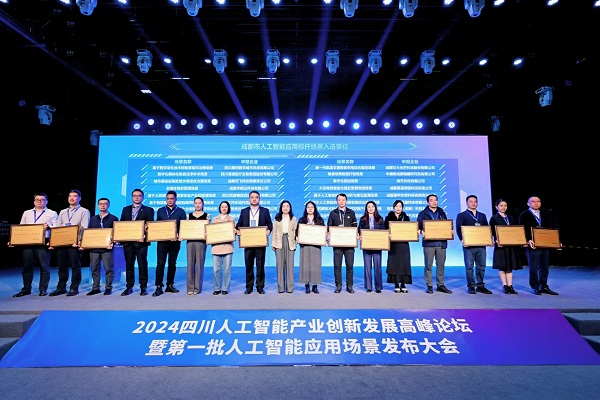
The 2024 Sichuan Artificial Intelligence Industry Innovation and Development Summit kicked off in Chengdu city, capital of Sichuan province, on Oct 25, unveiling achievements and lists of Chengdu's AI technological innovations, application scenarios, as well as supply and demand.
Specifically, the list of AI technological innovations covered 28 platforms including two research institutes, two computing power open innovation hubs, two pilot projects, four innovation centers, eight engineering centers and 10 laboratories. The list emphasized the promotion of new technologies, achievements and products, with 10 vertical large models such as SeaArt, Xingzhe.ai and WorkBrain.
Furthermore, the list highlighted the need to accelerate the research and development transformation of new technologies, achievements and products. It released 10 representative innovative products, including the high-performance high-integration neural network AI voice chip by Chipintelli and the autonomous controllable AI high-performance all-flash memory storage by TGStore. These products covered areas such as intelligent chips, robots, common tools and application systems.
Wang Xu, deputy director of the Chengdu science and technology bureau, said that with the widespread attention and participation of society, the list will surely lead to a thriving atmosphere in AI development.
Next, the bureau will announce 10 collaborative innovation projects in the industry chain; support 30 innovative product development projects; and improve the environment for technological innovation, scenario traction, sci-tech finance, talents and other services to collectively create an excellent innovation ecosystem, Wang said.
At the event, Ding Qin, secretary of the Communist Party's new economy development committee of the Chengdu bureau of economic and information technology, awarded the city's bench mark AI applications scenarios created by 16 enterprises in 2023, including smart city governance based on digital twin technology and digital modular smart clean surgery.
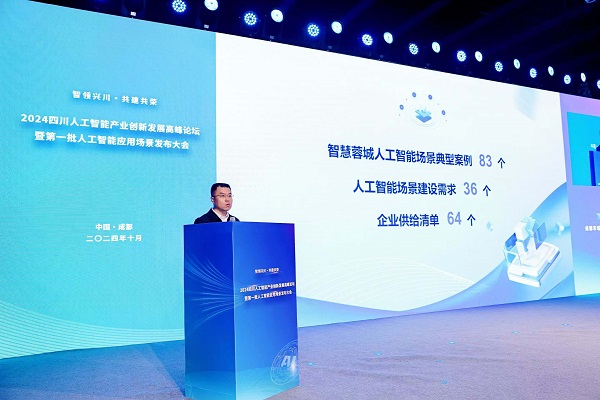
In addition, Feng Xiufu, secretary of the Party group of the Chengdu urban operation and government service office, showcased the latest achievements in Chengdu's AI field, releasing 83 typical cases of AI scenarios, 36 demands for AI scene construction and 64 supply capabilities of AI enterprises.
[Photo provided to chinadaily.com.cn]
Key agreements
During this event, the Sichuan Artificial Intelligence Institute signed agreements with several incubator companies such as Chengdu Guimu Robot, dedicated to the deep application of AI and big data in the maintenance of transportation infrastructure, and Lingtong Robotics (Shanghai) to boost close cooperation in the industry chain.
"The research institute can provide us with market and capital resources. Based on the company's technical team, both parties can engage in new product development in smart transportation and smart road maintenance," said Huang Can, assistant to the chairman of Guimu. "Next, we will deepen cooperation and mutual empowerment in market expansion, product development, and investment and financing."
Due to the promising environment for AI industry development in Chengdu, Lu Jie, founder and CEO of Lingtong Robotics (Shanghai), decided to relocate the company's headquarters to Chengdu.
"We're focused on developing desktop humanoid robots of 40-60 centimeters, equipped with 34 tiny motorized skeletons, featuring emotional output, task execution functions and the ability to transform appearances based on cultural and creative IP images, similar to figurines," said Lu. "Leveraging our technological accumulation and advantages, we can accelerate mass production in Chengdu, allowing everyone to have a robotic companion in the future."
[Photo provided to chinadaily.com.cn]
Collaboration
Experts, scholars and industry leaders from the front lines of industry, academia and research also shared their insights on the trends in AI-related innovation and development.
Xu Zongben, academician of the Chinese Academy of Sciences and former vice-president of Xi'an Jiaotong University, focused on exploring and practicing the model of AI empowering new industrialization.
Xu believes that generative AI is expected to achieve efficiency improvements of more than 100 times, serving as a driver for digital economic development and the core of new productive forces.
Tian Qi, academician of the International Eurasian Academy of Sciences and chief scientist in AI at Huawei Cloud, introduced a series of works by his team on reconstructing three-dimensional or four-dimensional content from sparse data and showcased technological achievements through multiple cases.
Tian's team can recover three-dimensional assets from a small number of images, making new progress in video generation and scene reconstruction. "The boundaries between model generation and reconstruction are becoming increasingly blurred and the development is spiraling upwards, worthy of further exploration by everyone."
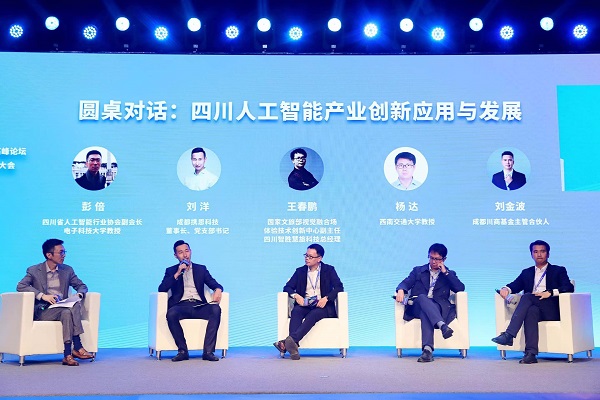
Roundtable discussions were also held under the theme of "innovative applications and development of Sichuan's AI sector", to speed up the integration of AI with various industries.
Liu Yang, chairman of Chengdu-based Shine Tech, elaborated on the significant role of AI in enhancing aircraft performance and developing new application scenarios, sharing examples of AI applications in individual and collective intelligence.
Wang Chunpeng, deputy director of the Ministry of Culture and Tourism's visual fusion field experience technology innovation center, discussed the application of AI in tourism. Wang mentioned that AI empowers the cultural and tourism industry, such as the use of drones to inspect scenic areas and ticket checking, as well as the potential of robotic dogs in carrying goods and companion services.
Wang believes that the application of AI in the cultural and tourism field is not just a demonstration of a single technology but a comprehensive application of various technologies in the coordination of air, land and people, with broad prospects for enhancing the efficiency and user experience.
AI industry
Chengdu has included AI as one of the key industry chains, bolstering the deep integration of sci-tech innovation and industrial innovation, achievement transformation and enterprise incubation.
The scale of the city's AI industry exceeded 78 billion yuan ($10.94 billion) in 2023, with an average annual growth rate of more than 40 percent in the past three years.
There are 950 AI enterprises in the city, including 634 high-tech enterprises, 715 technology-based small and medium-sized enterprises, and 62 national specialized and new "little giant" enterprises. There has been a blossoming of original achievements and technology companies in areas such as large models, humanoid robots, digital humans, AI painting, and AI music.



