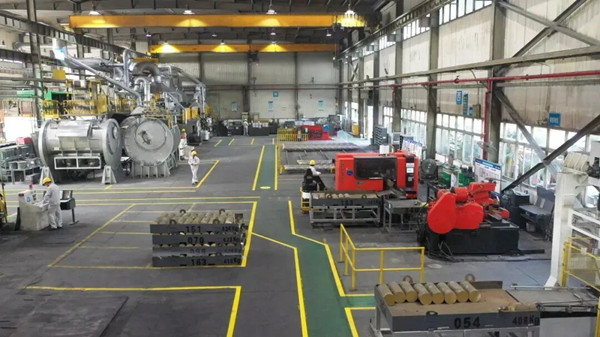
The AI application developed by Wuhan Fanzhou Chuetsu Metal Co in WEDZ. [Photo/WeChat account: whkfq]
The Ministry of Industry and Information Technology has unveiled the 2025 National Typical Applications for Artificial Intelligence (AI) aimed at enhancing small and medium-sized enterprises (SMEs).
Among the selected applications, two standout projects from the Wuhan Economic & Technological Development Zone (WEDZ) have been recognized, developed by Wuhan Fanzhou Chuetsu Metal Co and CCCC Wuhan Zhixing International Engineering Consulting Co.
Wuhan Fanzhou Chuetsu Metal Co, founded in 2002, is a leader in the research and production of high-strength, wear-resistant copper alloys. With an annual output of 10,000 metric tons of copper alloy pipes and bars and 40 million products, the company serves key industries including automotive, construction machinery, new energy, and robotics.
Its AI-driven application, titled "Large Model and Intelligent Agent Technology Empowering Intelligent Order Parsing and Transformation", employs cutting-edge technologies such as automatic data acquisition, format adaptation, multimodal text preprocessing, and the fine-tuning of large language models.
The innovation enables full-chain automation of order reception, parsing, and conversion, slashing order processing time from 1.5 hours to less than a minute, while achieving a 100 percent accuracy rate in extracting key information.
Zhixing International is at the forefront of digital transformation in the construction sector. Its AI application, designed for "Safety Hazard Inspection and Management in the Construction Industry", combines machine vision and AI technologies to streamline project production and operational processes, ensuring efficient safety hazard detection and closed-loop management.
"The deployment of these AI applications will accelerate the digital transformation of SMEs," said a representative from WEDZ. The zone is promoting the "AI+" initiative, aiming to establish a robust industrial ecosystem that encompasses hardware, software, computing power, and large models.