

Huzhou's agricultural heritage systems shine at top Asian conference
The 9th Conference of East Asia Research Association for Agricultural Heritage Systems, held from Sept 17 to 20 on Jeju Island in South Korea, spotlighted the Mulberry-Dyke and Fish-Pond System and the Deqing Freshwater Pearl Mussels Composite Fishery System from Huzhou, East China's Zhejiang province.
The systems have a long history in Huzhou, both acclaimed as globally important agricultural heritage systems.
The conference brought together experts, scholars, policymakers, and practitioners from East Asian countries, including China, Japan, and South Korea. They discussed the critical role of agricultural heritage amid the global climate crisis and explored paths for the sustainable use of agricultural heritage.
The Mulberry-Dyke and Fish-Pond System was praised for its eco-friendly, circular agricultural model, which is characterized as "raising silkworms with mulberry leaves, feeding fish with silkworm feces, and fertilizing mulberries with pond mud".
Moreover, diverse specialty products and cultural creations, produced and inspired by the system, were also exhibited.
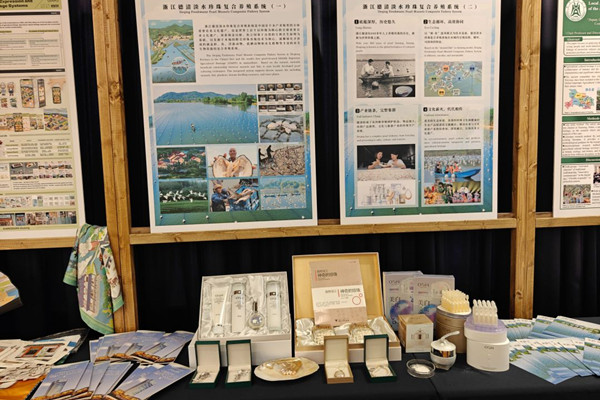
Pearl-based products from Huzhou in Zhejiang province, including skincare and jewelry, go on display. [Photo/Huzhou News and Media Center]
The Deqing Freshwater Pearl Mussels Composite Fishery System captivated international attention, highlighting its rich 800-year history and unique ecological agricultural value.
The system features an intricate aquaculture model based on the natural symbiotic relationship between fish and freshwater pearl mussels, centered around locally developed pearl cultivation techniques in Huzhou's Deqing county.
Deqing's exhibit at the conference also featured pearl-based products, including skincare, health supplements, crafts, and jewelry, drawing significant attention from attendees.


