
Nantong excels in rural vitalization over past 5 years
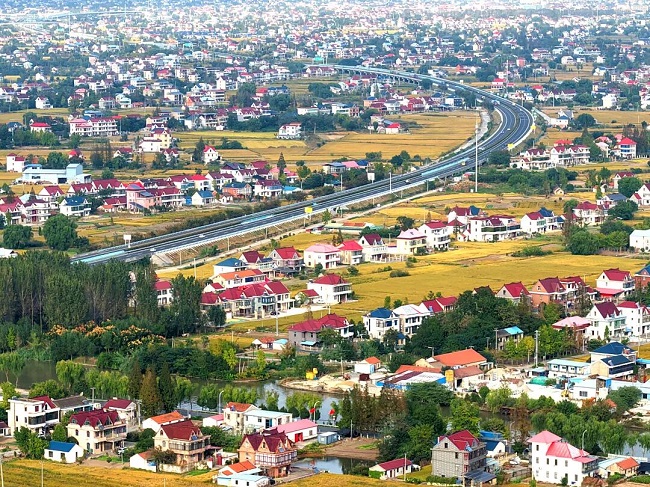
A bird's-eye view of rural Nantong. [Photo provided by Xu Congjun to en.nantong.gov.cn]
The Nantong municipal bureau of agriculture and rural affairs recently highlighted the city's remarkable achievements in high-quality agricultural and rural development during the 14th Five-Year Plan period (2021-25) at a press conference.
In 2024, stable income constituted 86.2 percent of the average collective operating income for villages across Nantong. Farmers' incomes have steadily increased, and the urban-rural income ratio has narrowed to 1.86.
As a national pilot city for promoting high-standard farmland construction, Nantong has developed over 1.74 million mu (116,313 hectares) of high-standard farmland from 2021 to 2025. The city has also reformed and established regional agricultural technology service centers and was the first in the province to pilot comprehensive mechanization of agricultural production during the period, with a mechanization rate of 90.3 percent for crop cultivation and harvesting.
Nantong has developed four agricultural industrial chains, each exceeding 10 billion yuan ($1.42 billion), focusing on high-quality grain and oil, large-scale livestock and poultry, specialty aquatic products, and green fruits and vegetables since 2021. For instance, the city's grain planting area has consistently exceeded 8.04 million mu, with total production stabilized at over 3.4 million metric tons.
The city has also accelerated the development of new industries and business models such as rural tourism and rural e-commerce since the beginning of the 14th Five-Year Plan period. The number of annual visitors coming to experience leisure agriculture exceeded 30 million, generating revenue of over 7 billion yuan, while annual e-commerce sales of agricultural products approached 6.5 billion yuan.
Nantong has implemented a project to enhance the living environment in rural areas over the past five years, resulting in 242 villages being recognized as provincial livable and business-friendly beautiful villages.
In the next five years, local authorities will remain committed to further enhancing agricultural efficiency and benefits, increasing farmers' incomes, and invigorating rural communities.




 TRANSPORTATION
 EDUCATION
 HEALTHCARE
 USEFUL NUMBERS