


'Son of Tibet' revels in plateau's bright future
Updated: 2019-03-27China Daily
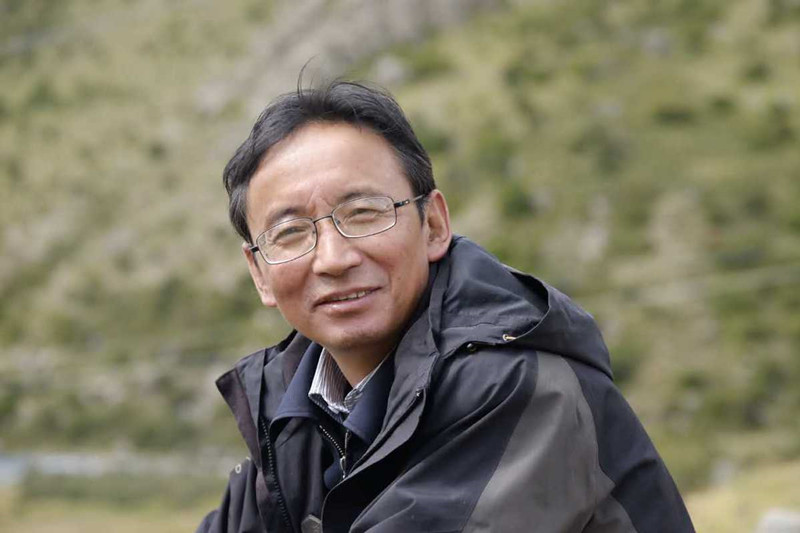
A file photo of Thubten Khedrup, a member of the National Committee of the Chinese People's Political Consultative Conference, the nation's top political advisory body. [Photo provided to China Daily]
Proud boast
Earlier this month, Thubten Khedrup was one of the 2,000-plus political advisers who attended the second session of the 13th National Committee of the CPPCC.
Members of the committee come from a range of backgrounds, including scientists, officials, entrepreneurs, artists and religious figures. They gather at the annual session to discuss major political, economic and social issues.
"Being a political adviser is not only an honor, it is also a responsibility," Thubten Khedrup said.
He is also proud of another identity-a son of Tibet. "I even use it as my name on social media," he said.
Born in a herdsman's family in Joda, a county in Chamdo city, Thubten Khedrup is grateful that as a professor at Tibet University he has lived up to his dream of becoming a teacher.
"I am the son of one of the 1 million serfs who were emancipated with the help of the Communist Party of China 60 years ago," he said. "Thanks to the CPC, I can be what I am today."
After graduating from Southwest Normal University in Chongqing in 1988, Thubten Khedrup had many opportunities to work in China's wealthy coastal provinces.
However, he was desperate to return to Tibet to work as a teacher, even as a primary school teacher in a remote town.
"We Tibetan people highly appreciate teachers, because teachers mean wisdom," he said.
In his 30-plus years at Tibet University, he has researched the problems facing the region and shared his findings with the government and his students.
Brought up in the plateau region, Thubten Khedrup developed a great interest as a college student in any Tibet-related topic.
"I am eager to know more about Tibet, and I hope conditions can improve," he said.
"Identifying problems in Tibet's development and coming up with solutions is how I fulfill my obligations as a political adviser."
As an expert in the Tibetan economy and tourism sector, he has visited many places, both in China and overseas, since 2008.
Thubten Khedrup will never forget a trip to France in 2010 when a group of foreigners challenged him about the human rights situation in Tibet.
"I'm a teacher and I like to answer questions. I would like to teach you that human rights include the right to live and develop. Instead of preaching, I will give you an example: I am the son of a serf in old Tibet. If today's Tibet was as bad as you describe, how could I sit here to have a meeting with you in France?" he told them.
"Tibetan people should have the confidence to pursue their happiness, never mind what others say," he said.
Initially, he discovered that Tibetans living overseas had doubts about the situation in the region. Gradually, though, they have learned about the rapid development of Tibet from television and friends. Some even envy the people living in Tibet and regret living in exile.
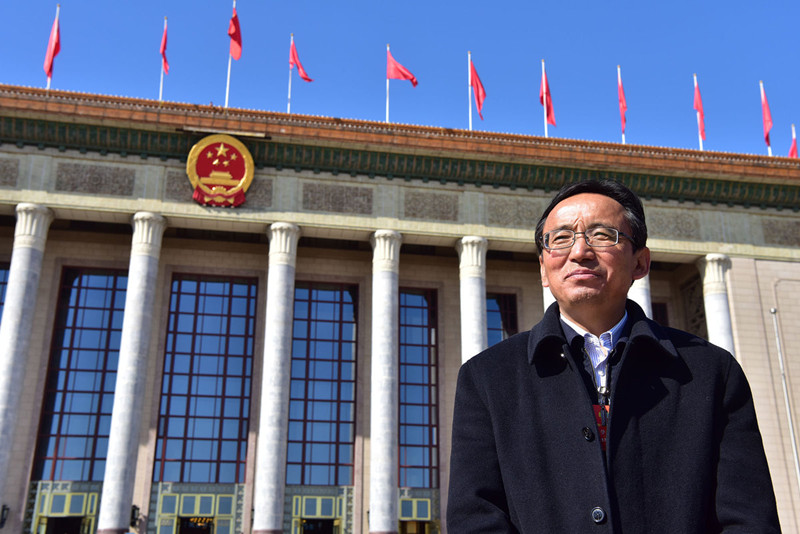
Thubten Khedrup, a member of the National Committee of the Chinese People's Political Consultative Conference, the nation's top political advisory body, stands in front of the Great Hall of the People in Beijing, March 8, 2019. [Photo/China Daily]
Storyteller
Thubten Khedrup's objective as a political adviser is to tell Tibet's story to more people.
Anyone who intends to apply for a PhD or a postgraduate position supervised by Thubten Khedrup must meet his three requirements: know Tibet; thank Tibet; and serve Tibet.
"Serving Tibet does not mean they have to stay in Tibet forever. They can go anywhere after graduation. Wherever they go, they will tell stories of Tibet to help more people learn about Tibet," he said.
Tibetan people are living harmonious lives now. Public security in Lhasa is among the best in the world, according to Thubten Khedrup.
"In Lhasa, you don't have to carry your rucksack in front of your chest as people do in some other places," he said.
"People in Tibet respect doctors and teachers. You rarely see medical disputes here. Female taxi drivers dare to drive at midnight.
"As a Tibetan born in the early 1960s, my own story reflects Tibet's change and development over the past 60 years since the democratic reform in 1959."
Thubten Khedrup supervises nine PhD students from different ethnic groups.
Some of his previous students graduated from the postgraduate school of Tsinghua University, one of China's top schools, or prominent universities overseas, including the London School of Economics in the United Kingdom.
"To know Tibet well and tell Tibet's story well, I still have a long way to go," he said.
Copyright © The National Committee of the Chinese People's Political Consultative Conference.
All rights reserved. Presented by China Daily.