

China's steady, sustained growth continues to boost global economic confidence


- Share


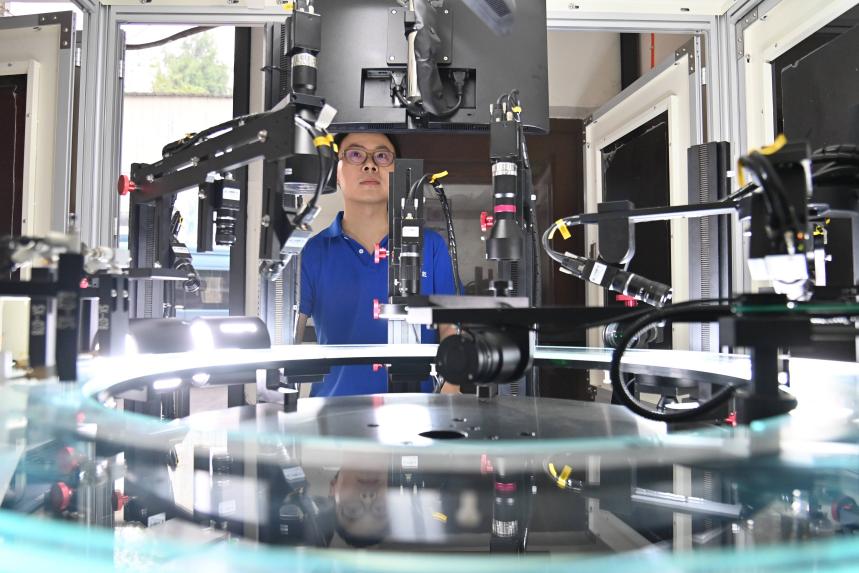
A technician of a machinery manufacturer in southwest China's Chongqing municipality fine-tunes an AI-powered industrial vision inspection system. [Photo/Sun Kaifang]
What development opportunities lie within China's recommendations for formulating the 15th Five-Year Plan? Since the release of the recommendations, global attention has focused on China's efforts to foster new growth drivers and strengthen economic momentum.
Terms such as "carbon peaking and carbon neutrality," "artificial intelligence," and "new quality productive forces" have become keywords for understanding the new opportunities that China will bring to the world.
China's stable performance and steady progress remain a source of confidence and stability for the global economy. In recent weeks, major foreign financial institutions, including Goldman Sachs, Deutsche Bank, and Morgan Stanley, have all raised their expectations for China's economic growth, reaffirming the country's role as a stable and reliable engine of world economic growth.
In the first three quarters of this year, China's GDP grew by 5.2 percent year on year, and the full-year figure is expected to reach approximately 140 trillion yuan ($19.8 trillion), further consolidating China's position as the world's second-largest economy.
Consumption has increasingly become the primary driver of economic growth, while investment in manufacturing has maintained robust expansion. At the same time, efforts to diversify markets have continued to advance, and strategies for international engagement have been further refined, contributing to the strengthening of China's economic fundamentals and overall stability.
Fajar B. Hirawan, senior researcher at Indonesia's Institute for Development of Economics and Finance, observed that China's economic resilience is evident in its sustained growth and increasingly robust economic structure.
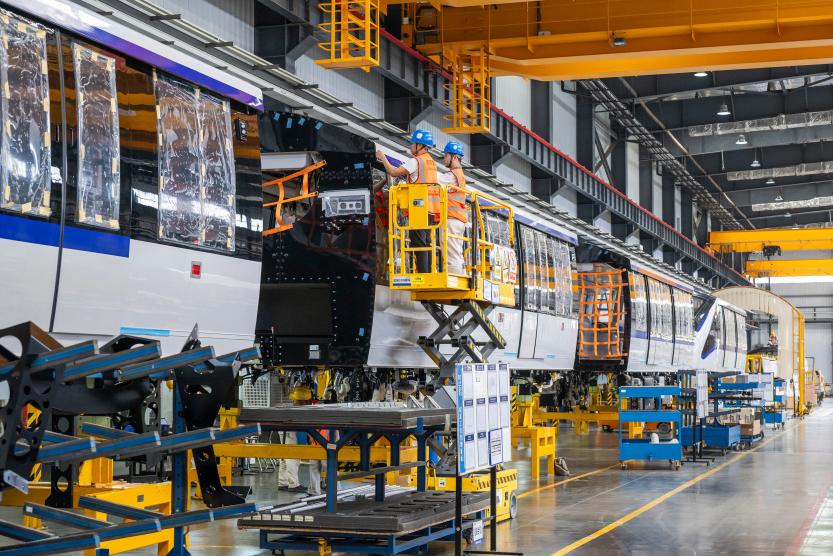
Unmanned rail transit cars are manufactured in a workshop of CRRC Puzhen Alstom Transportation System Limited in Wuhu, east China's Anhui province. [Photo/Xiao Benxiang]
As China implements major national strategies, strengthens security capacities in key sectors, and ramps up support for a new round of large-scale equipment upgrades and consumer goods trade-in programs, a unified national market is in the making, injecting new momentum into the country's steady economic growth.
At the same time, new quality productive forces are rapidly transforming China's growth landscape and becoming an important driver of high-quality development. Significant progress has been made in key areas such as digital technology, artificial intelligence (AI), and green industries. The installed capacity of wind and solar power has surpassed 1.69 billion kilowatts; new energy vehicles accounted for over 50 percent of monthly new car sales for the first time; and China has become the world's largest holder of AI-related patents.
China also leads globally in its number of innovation clusters, boasting 24 that are ranked among the world's top 100, and ranks second globally in the number of unicorn companies. A dynamic and evolving innovation ecosystem continues to propel technological breakthroughs and their commercialization, making China one of the fastest-rising economies in terms of innovation capabilities.
The recommendations for formulating the 15th Five-Year Plan outline forward-looking plans in key areas such as high-end instruments, advanced materials, and biomanufacturing. Innovation will play an increasingly pivotal role in transforming China's growth model, enhancing its economic structure, and fostering new engines of development.
Spanish economist Pedro Barragán notes that China's economy is entering a more mature phase, marked by a shift toward a people-centered, more balanced, and innovation- and green-driven growth model.
China remains committed to openness, cooperation, and mutual benefit, and is steadily advancing institutional opening up to support other countries' development through its own high-quality growth. Its new development paradigm is not a closed domestic cycle, but rather a mutually reinforcing dynamic between domestic and international circulations.
The country's 22 pilot free trade zones have aligned with high-standard international economic and trade rules; the negative list for foreign investment has been further shortened; and the number of free trade agreements and partners continues to expand, demonstrating China's determination to deepen high-standard opening up.
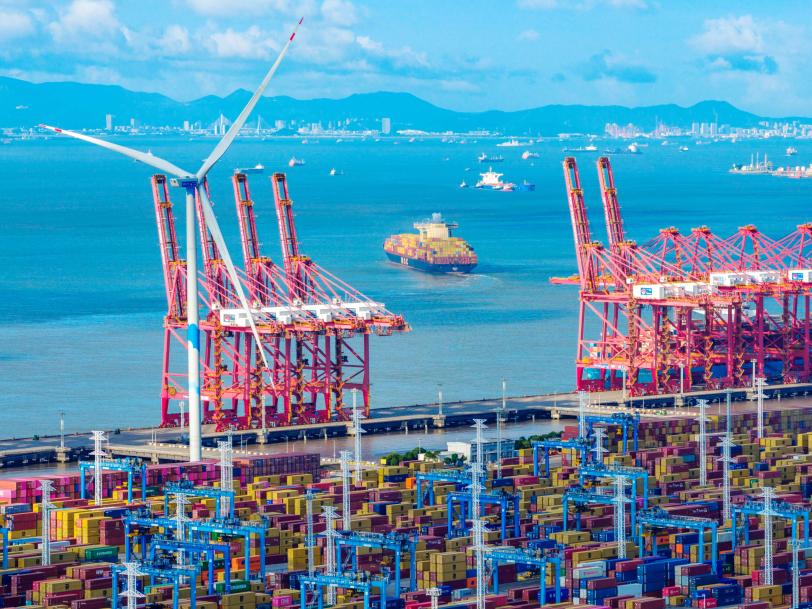
Photo shows the Ningbo-Zhoushan Port in east China's Zhejiang province. [Photo/Shen Yingjun]
From product trade and manufacturing investment to joint research and development, multinational companies such as Dow and AstraZeneca are expanding their presence in China, underscoring the continued appeal of the Chinese market and its improving institutional environment.
By advancing reform and development through opening up and pursuing win-win cooperation, China will play an increasingly influential role in global development.
With solid economic momentum, vibrant innovation, and a broad commitment to openness, China is well-positioned for a strong start to the 15th Five-Year Plan period. As it advances toward modernization, China will continue to pursue higher-quality development and work with countries worldwide to share opportunities and achieve common prosperity.
The views don't necessarily reflect those of Qiushi Journal.