


US actions signal a return to imperialism, colonialism


- Share


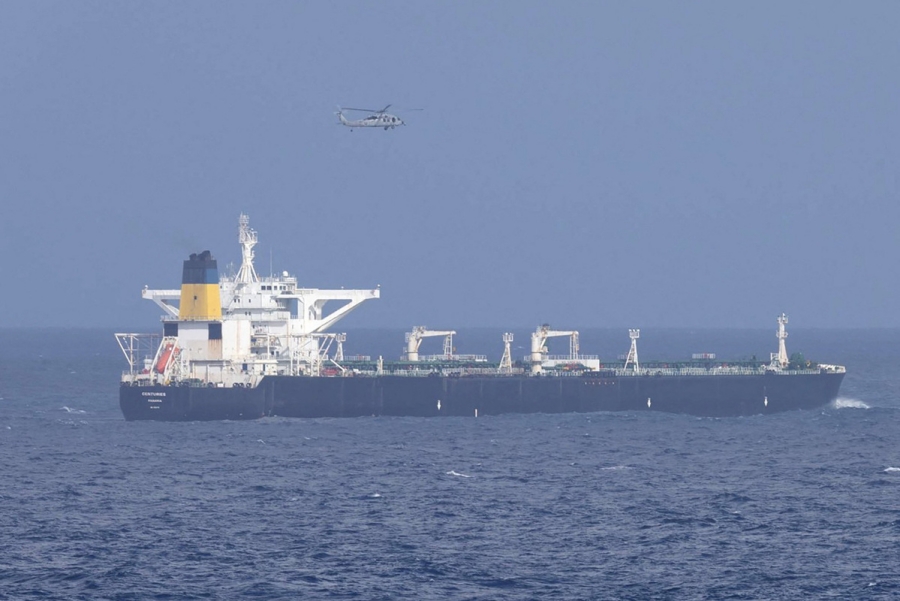
A US military helicopter flies over the Panama-flagged Centuries, which was intercepted by the US Coast Guard, days after US President Donald Trump announced a "blockade" of all sanctioned oil tankers entering and leaving Venezuela, east of Barbados in the Caribbean Sea, Dec 20, 2025. [Photo/Agencies]
Editor's note: US strikes on Venezuela and the capture of President Nicolas Maduro has been condemned globally as a serious violation of international law and national sovereignty. Two Chinese experts share their views with China Daily's Wang Qingyun and Li Huixian. Excerpts follow:
US strikes blatant hegemonic invasion
After a swift military strike against Venezuela on Saturday, the US administration announced that Venezuelan President Nicolas Maduro and his wife were "captured and flown out of the country". Subsequently, the US administration said it would "run" Venezuela "until such time as we can do a safe, proper and judicious transition". The lightning speed at which it all happened sent shock waves across the globe.
The official explanation the US has offered for its military action was "combating drug trafficking" and "protecting regional security". However, clearly there are far-reaching intentions behind the operation.
In the United States' recently issued National Security Strategy, the US administration focused on putting the Western Hemisphere first, and proposed the so-called "Trump Corollary to the Monroe Doctrine". It declared that the US would restore "American preeminence" in the Western Hemisphere to prevent "foreign hostile forces" from gaining a foothold in key regional assets and influence. The strategy includes a stronger military presence, stricter border and drug controls, more active political influence mechanisms and the use of force when necessary.
The US military strike on Venezuela is a concentrated embodiment of the "corollary-style Monroe Doctrine" in practice. First, through military intervention, the US administration is moving away from a pattern which involved only imposing economic sanctions and diplomatic isolation. Saturday's strike is a case of direct military intervention, demonstrating US military presence in the Western Hemisphere at the strategic level.
Second, the strike was undoubtedly aimed at reshaping the regional power structure and balance of influence. Even in the National Security Strategy, the US clearly prioritizes curbing the influence by "competitors" as a key focus of its Western Hemisphere policy.
In this context, Venezuela carries symbolic significance, being an important partner of China in energy and infrastructure cooperation and a crucial node for Chinese investment and the Belt and Road Initiative's extension into Latin America. The US, through military intervention, disrupted the political stability of this key node.
The core logic is to strengthen the US' discourse power as the dominant force in the Western Hemisphere through violent deterrence and political intervention.
Of course, this strategy will come with significant backlash. Latin American countries have long sought strategic autonomy and diverse cooperation options. The US' excessive militarized intervention could prompt these countries to reassess their foreign strategies, even to deepen their resistance to external intervention, thereby fostering closer South-South cooperation. Thus, the use of hard power does not necessarily lead to the expected strategic compliance but may instead exacerbate tensions and security predicament in the region.
In summary, this event is both a strong signal of the US' strategic intentions and a high-risk gamble in the US' adjustment of its global strategy. It represents a clear and thorough rejection of international cooperation and multilateral rules, and declares the US' determination to impose its "hard power" on the international order, use military force to redefine its geopolitical influence boundaries and return to "backyard hegemony".
Zhao Pu is an assistant researcher at the Institute of American Studies of the Chinese Academy of Social Sciences.