

Understanding the Major Points and Requirements of the Recommendations for Formulating the 15th Five-Year Plan for National Economic and Social Development


- Share


The Recommendations of the Central Committee of the Communist Party of China for Formulating the 15th Five-Year Plan for National Economic and Social Development (hereinafter referred to as the “Recommendations”) is the third five-year plan recommendations formulated in the new era which began in 2012, as well as the first such recommendations on the new journey toward building a modern socialist country. It serves as a programmatic document to ensure decisive progress in basically realizing socialist modernization and represents yet another overarching blueprint and call to action for further advancing Chinese modernization based on the progress we have made thus far. The Recommendations holds great significance for the full implementation of the strategic plans outlined at the 20th National Congress of the Communist Party of China (CPC), held in 2022, and the advancement of Chinese modernization.
I. The drafting process for the Recommendations provides yet another vivid example of intra Party democracy and whole-process people’s democracy in practice
From May 20 to June 20, 2025, official websites and news clients of the People’s Daily, Xinhua News Agency, China Media Group, as well as the online platform xuexi.cn launched special columns to solicit opinions and suggestions from all sectors of society regarding the 15th Five-Year Plan (2026-2030). A total of over 3.11 million online suggestions were received. Following the online solicitation of public input on the formulation of the 14th Five-Year Plan (2021-2025), this is another effort to seek public opinions and suggestions from all sectors of society via the Internet on national formulation. It is a vivid demonstration of whole-process people’s democracy as the broadest, most genuine, and most effective form of democracy.
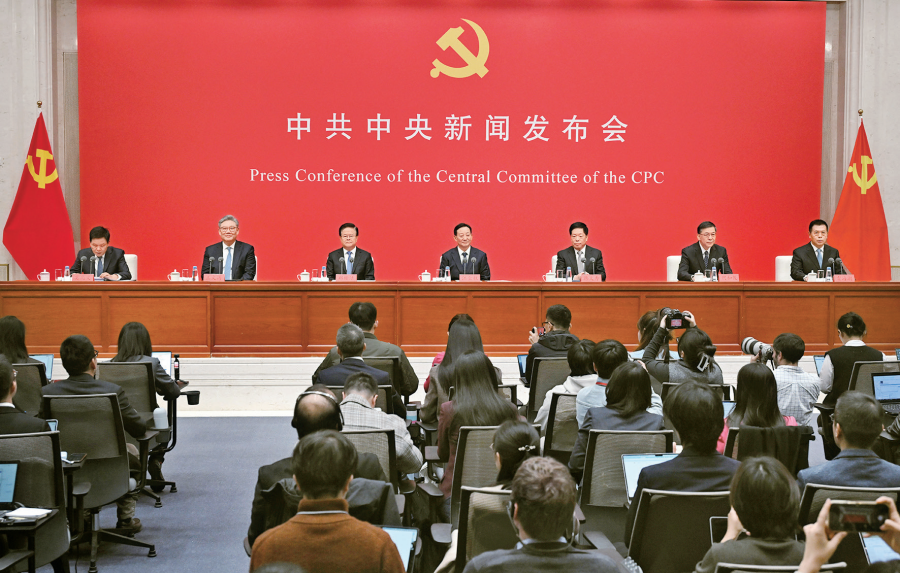
The CPC Central Committee holds a press conference to outline and interpret the guiding principles of its fourth plenary session, October 24, 2025. PHOTO BY XINHUA REPORTER JIN LIANGKUAI
The formulation of the five-year plan involves all aspects of economic and social development and is closely related to the work and lives of our people. General Secretary Xi Jinping has emphasized on many occasions the importance of extensively soliciting opinions and suggestions in the drafting of the plan, advocating for sound, democratic, law-based decision-making, and the combination of top-level design with public consultation.
The drafting of the Recommendations was conducted throughout the process under the firm leadership of the CPC Central Committee with Xi Jinping at its core and steadily progressed in alignment with its top-level design and strategic blueprint. As early as the third plenary session of the 20th CPC Central Committee held in July 2024, General Secretary Xi put forward requirements for the preliminary planning of the 15th Five-Year Plan. In January 2025, the Political Bureau decided to establish a drafting group for the documents of the fourth plenary session of the 20th CPC Central Committee, with General Secretary Xi leading the group himself. On February 11, General Secretary Xi presided over the first full meeting of the drafting group and delivered an important speech, in which he profoundly expounded the significant implications of formulating the Recommendations, and the key issues and strategic tasks requiring in-depth study, and set forth clear requirements for the drafting work. During the drafting process, General Secretary Xi presided over meetings to seek opinions from leading officials of seven provinces, autonomous regions, and municipalities directly under the central government as well as prominent non-CPC citizens. He successively presided over three meetings of the Standing Committee of the Political Bureau and two meetings of the Political Bureau to hear reports on the progress of the drafting work, guide the research on major relevant issues, and offer important revisions.
The drafting of the Recommendations was a democratic process that collected a wide range of ideas. On January 22, 2025, the Central Committee issued the Notice on Soliciting Opinions on Recommendations for the 15th Five-Year Plan to Be Studied at the Fourth Plenary Session of the 20th CPC Central Committee in order to gather ideas from both Party members and non-Party figures. In late February, the Central Committee organized six teams to conduct studies in 12 provincial-level regions. Between May 20 and June 20, online public consultation for the formulation of the 15th Five-Year Plan garnered broad participation and representation, during which comments collected were reviewed and condensed into over 1,500 suggestions. On August 4, the Central Committee issued a draft document calling for input from all regions, departments, and relevant organizations, for which a total of 2,112 suggestions were received. During the plenary session, following comprehensive discussions, the participants put forward 176 suggestions for revision. Through extensive consultation and in-depth research, insights from both Party members and non-Party figures were effectively integrated, and broad consensus was achieved, thereby ensuring that the tasks and measures outlined in the Recommendations are grounded in sound theoretical and practical foundations.
Democracy is not only manifested in the process of broad solicitation of public input, but also in the moral guidance and the effective integration and implementation of such public input. During the drafting of the Recommendations, the drafting group worked through these submitted opinions and suggestions one by one and incorporated as many of them as possible into the text. In total, they made 218 additions, revisions, and simplifications to the document based on 452 opinions and suggestions, resulting in a formal feedback incorporation rate of 21.4%. The Recommendations reflects a deep concern for people’s wellbeing, simultaneously addressing both macro-level strategies and grassroots needs. It not only charts a grand blueprint for national development but also paints a picture of individual wellbeing, demonstrating a people-centered approach and reaffirming the meeting of the people’s aspirations for a better life as the ultimate goal of Chinese modernization.
II. The 15th Five-Year Plan period will be critical in the process as we work to reinforce the foundations and push ahead toward basically realizing socialist modernization by 2035
Understanding the significance of the 15th Five-Year Plan period
The 20th CPC National Congress put forward a two-step strategic plan for building China into a modern socialist country and advancing toward the Second Centenary Goal. The first step, which aims to basically realize socialist modernization by 2035, requires sustained and concerted efforts spanning three consecutive five-year plans from the 14th to the 16th (2021-2035). We have succeeded in achieving a good start during the 14th Five-Year Plan period by laying solid foundations. Subsequently, the 15th Five-Year Plan period occupies a central and transitional position in the national development trajectory. During this period, we must consolidate and build on our strengths, remove development bottlenecks, and shore up areas of weakness to further solidify our foundations for development. At the same time, efforts should be directed toward ensuring coordinated implementation of the Five-Sphere Integrated Plan and the Four-Pronged Comprehensive Strategy, aiming to secure major breakthroughs in strategic tasks of overall importance to Chinese modernization. This will further consolidate the foundations for basically realizing socialist modernization in the coming 16th Five-Year Plan period (2031-2035).
Understanding the development environment of the 15th Five-Year Plan period
During this period China’s development environment will face profound and intricate changes. It is clearly stated in the Recommendations that relations between major countries have an important bearing on the international landscape, the dynamics of which will in turn exert a profound impact on the domestic development of every country. China finds itself in a period of development where strategic opportunities exist alongside risks and challenges, while uncertainties and unforeseen factors are rising. At the same time, it is important to recognize that China possesses numerous positive factors enabling it to make proactive moves in the international arena and shape a favorable external environment. The Chinese economy has a solid foundation, advantages in many areas, strong resilience, and great potential. The conditions for and underlying trend of long-term growth remain unchanged. We must maintain strategic resolve and enhance our confidence of success. We should fully leverage the strengths of socialism with Chinese characteristics, China’s enormous market, its complete industrial system, and its abundant human resources, and effectively transform these advantages into tangible drivers of high-quality development.
Understanding the major objectives for economic and social development in the 15th Five-Year Plan period
An important benchmark for basically realizing socialist modernization by 2035 is that China’s per capita GDP will be on a par with that of a mid-level developed country by that time. This dictates that we must maintain an appropriate rate of economic and social development during the 15th Five-Year Plan period. On the basis of thorough research and scientific analysis, the draft document puts forward a range of important objectives, such as ensuring the economy keeps growing within an appropriate range and ensuring personal incomes increase in step with economic growth. In alignment with the two-step strategic plan for building China into a great modern socialist country, it identifies principal objectives for economic and social development across seven key areas: high-quality development, scientific and technological self-reliance and strength, deeper all-round reform, cultural and ethical progress across society, life quality of the people, the Beautiful China Initiative, and strengthening the national security shield. These objectives comprehensively consider developmental needs and potential, take into account both immediate priorities and long-term objectives, and balance proactivity and progress with stability and practical feasibility. They will serve as the guiding framework and a strategic reference for development over the next five years. We must remain oriented toward our goals and outcomes, systematically translating strategic objectives into concrete measures and specific tasks. By doing so, we will transform this grand vision into tangible achievements and ensure decisive progress toward the basic realization of socialist modernization.
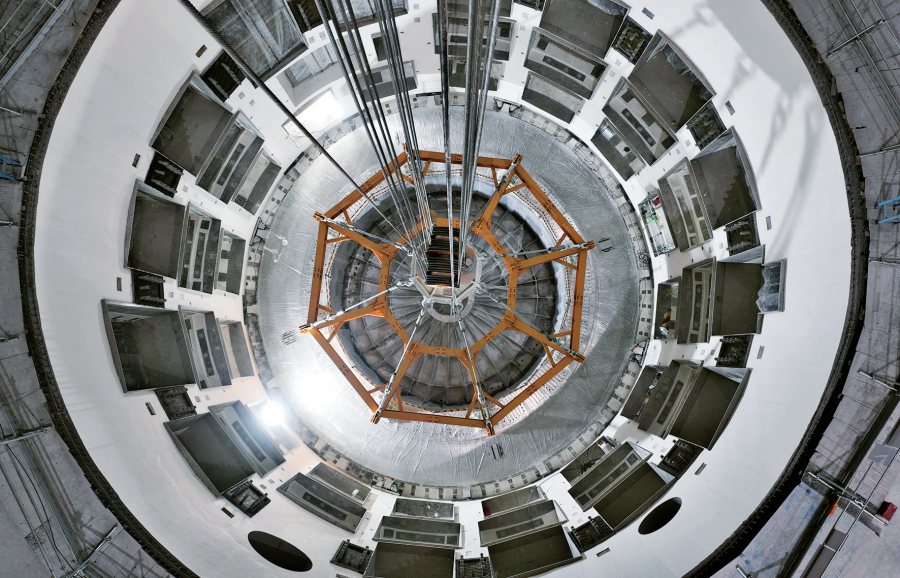
The Dewar base is installed at the construction site of the Burning Plasma Experimental Superconducting Tokamak (BEST), located at the Future Big Science City, Hefei, Anhui Province, October 1, 2025. This marked the successful installation of the first key component of BEST, a compact fusion experiment device, which opens a new phase in the construction project (drone photo). PHOTO BY XINHUA REPORTER ZHOU MU
III. The essentials and key issues of the Recommendations
The draft document consists of 15 parts divided into 3 main sections, encompassing a total of 61 articles and approximately 20,000 words. It defines the guiding philosophy, core principles, and major objectives for economic and social development during the 15th Five-Year Plan period and outlines the strategic tasks and main measures necessary to achieve these objectives, thereby serving as a comprehensive action plan for China’s medium- to long-term social and economic development.
High-quality development is our primary task in building China into a modern socialist country. During the 15th Five-Year Plan period, we must continue to pursue high-quality development. The Recommendations defines the promotion of high-quality development as the main focus in economic and social development in the 15th Five-Year Plan period, carrying forward the approaches from the 14th Five-Year Plan and outlining strategic tasks based on an accurate understanding of the general trends in China’s development for the next five years. At present, the new round of technological revolution and industrial transformation has given rise to more intense competition, and strategic technologies, such as artificial intelligence, are profoundly changing the ways people work and live. However, we must be aware that some problems still exist: China continues to lag behind most advanced countries in terms of capacity for scientific and technological innovation; our traditional industries, while large in size and extensive in scope, are not yet strong or sophisticated enough; and strategic emerging industries have weak foundations in core technologies in key fields. Therefore, there is an urgent need to give higher strategic priority to developing new quality productive forces in line with local conditions and respond to uncertainties of a dramatically changing external environment with the certainty provided by high-quality development. The Recommendations highlights the guiding role of scientific and technological innovation and makes specific plans for modernizing the industrial system, boosting self-reliance and strength in science and technology, and accelerating the green transition across the board. In seeking to reinforce the foundations of the real economy, we should upgrade traditional industries and foster emerging industries and industries of the future. As we seek to develop new quality productive forces, we should promote advances in original innovation and breakthroughs in core technologies in key fields and boost full integration between technological and industrial innovation. In order to build a Beautiful China, we should press ahead with the critical battle against pollution and the drive to upgrade ecosystems and accelerate the shift to eco-friendly production practices and lifestyles.
Fostering a new development dynamic is the path we must take to advance Chinese modernization. During the 15th Five-Year Plan period, we must strengthen the domestic economy and promote unimpeded domestic and international economic flows. In today’s world, the threats of unilateralism, protectionism, hegemonism, and power politics are on the rise. The international economic and trade order faces grave challenges, and global economic growth lacks steam. We must be fully aware that a hallmark and distinctive strength of large economies is that they can function internally as a circulating loop driven by the dominant role of domestic demand. The Recommendations highlights the need to strengthen the domestic economy and makes specific plans regarding the development of a robust domestic market and a high-standard socialist market economy. Seeking to enhance the dynamism and reliability of the domestic economy, we must pursue the strategy of expanding domestic demand, boost consumption, and expand effective investment. We should make thorough efforts to develop a unified national market, eliminate local protectionism and market segmentation, and address rat race competition through holistic measures in order to fully unleash the potential of China’s enormous market. In attempting to boost momentum for high-quality development, we should stimulate the vitality of all market entities, improve the institutions and mechanisms for market-based allocation of production factors, and work to improve the efficacy of macroeconomic governance. At the same time, we should also intensify our efforts to promote broader international economic flows, advance high-standard opening up, and coordinate the use of global production factors and market resources.
Achieving common prosperity for all is an essential requirement of Chinese modernization. As such, we must make solid strides toward delivering prosperity for all during the 15th Five-Year Plan period. In the new era, China’s per capita disposable income has increased to 41,314 yuan, and its population’s life expectancy has grown to 79 years. Our basic old-age insurance and basic medical insurance now cover 1.07 billion people and 1.33 billion people respectively. We have improved public wellbeing steadily in the course of development and ensured a more complete and lasting sense of gain, happiness, and security for our people. Yet, we must acknowledge that our people are still confronted with some difficulties in employment, education, social security, housing, medical care, eldercare, marriage, childbirth, and childcare, and wide gaps persist in development and income distribution between urban and rural areas and between regions. Firmly anchored in the goal of common prosperity for all, the Recommendations sets out clear requirements for public wellbeing, rural revitalization, coordinated regional development, and cultural vitality. To ensure and improve public wellbeing, we should promote high-quality and full employment, refine the income distribution system, and take solid steps to ensure equitable access to basic public services. In regard to narrowing disparities between rural and urban areas and between regions, we should steadily advance all-around rural revitalization and promote coordinated regional development. In order to ensure a rich cultural life for all, we should promote and practice the core socialist values and extend the reach and appeal of Chinese civilization.
National security provides a crucial foundation for ensuring steady and sustained progress in Chinese modernization. In the 15th Five-Year Plan period, we must ensure both high-quality development and greater security. The changes we see in the world are intertwined with disturbances; turmoil continues to mount; geopolitical conflicts flare up all too easily and frequently; and competition among major countries is becoming fiercer and more complex. Meanwhile, as structural, institutional, and cyclical problems are interlaced in China’s development, the task of ensuring national security has become much more difficult and demanding. This is the current situation and will remain so for some time to come. The Recommendations identifies ensuring both development and security as one of the core principles we must follow in the 15th Five-Year Plan period and devotes sections specifically to making overall plans regarding modernizing China’s national security system and capacity as well as modernizing national defense and the armed forces, which highlights the extreme importance of ensuring both security and development for our country’s overall development. In advancing the Peaceful China Initiative to a higher level, we should establish a sound national security system, build up national security capacity in key sectors, enhance public safety governance, and improve the social governance system. In order to achieve the centenary goals of the People’s Liberation Army by 2027, we must speed up the development of advanced combat capabilities, modernize military governance, and consolidate and improve integrated national strategies and strategic capabilities.
IV. How to ensure the implementation of the Central Committee’s decisions and arrangements for the 15th Five-Year Plan
The worth of any plan lies in its implementation. A blueprint has been drawn up for China’s economic and social development during the 15th Five-Year Plan period. The key is to promote the effective implementation of all decisions and plans with relentless perseverance based on a deep and accurate understanding on a fundamental level.
Upholding and strengthening the CPC’s overall leadership
This is the fundamental guarantee for advancing Chinese modernization. Seeking to improve our Party’s ability to lead China’s economic and social development endeavors, the Recommendations emphasizes the need to uphold and strengthen the Central Committee’s centralized, unified leadership, refine the mechanisms through which the Central Committee’s major decisions and plans are carried out, and continue to apply our Party’s new theories to achieve unity in thinking, will, and action. We must use CPC’s self-reform to steer social reform and stay committed to strengthening full and rigorous Party self-governance. We must ensure our Party continues to improve its ability to provide political leadership and theoretical guidance, organize the people, and inspire society, encouraging Party members and officials to take on responsibility and make solid progress in their work. All of this will enable us to garner a mighty force for advancing Chinese modernization.
Formulating 15th five-year plans and sector-specific plans
The Recommendations has set the course for China’s economic and social development over the next five years. We must formulate national and local 15th five-year plans and sector-specific plans in accordance with the guidance provided in the Recommendations, which entails a concrete manifestation of implementing the Central Committee’s decisions and plans and represents an important task at present. All types of plans at all levels must be formulated in line with the decisions and arrangements set forth in the Recommendations, ensuring that they are forward-looking, play a guiding role, and are designed to be highly practicable and feasible. We should apply systems thinking, act consciously in big-picture terms, and coordinate the efforts of the whole country. We should be adept at “playing the piano,” ensure coordination between policies in all areas, maintain the consistency of macro policy orientations, and prevent and overcome departmentalism and local protectionism.
Mobilizing the initiative, enthusiasm, and creativity of the whole of society to advance Chinese modernization
To build China into a modern socialist country is a shared undertaking of hundreds of millions of Chinese people. Acting on the people-centered development philosophy, we should redouble efforts to unite and mobilize the people and guide them to turn the fulfillment of economic and social development objectives for the 15th Five-Year Plan period into conscious action, so as to create a better future together. Based on the principle of respecting work, knowledge, talent, and creativity, we should harness the drive, enterprise, innovation, and ingenuity of the whole of society and foster a vibrant environment where all our people can realize their full potential, put their talents to best use, and press ahead together with one heart and one mind.
Establishing effective working mechanisms for ensuring the implementation of plans
Our key focus is to align all types of policy instruments with the arrangements outlined in the Recommendations and leverage the synergy of macro policies, annual plans, and public resources to underpin and guarantee the fulfillment of the 15th Five-Year Plan. To ensure effective implementation, we should refine mechanisms for policy coordination and work collaboration and strengthen support from fiscal, financial, and other policies. We should improve the monitoring, evaluation, and oversight of the implementation of these plans and promptly discover and resolve problems as they arise in order to facilitate the accomplishment of all tasks.
(Originally appeared in Qiushi Journal, Chinese edition, No. 21, 2025)