

Profound and Intricate Changes Facing China’s Development Environment During the 15th Five-Year Plan Period


- Share


The Recommendations of the Central Committee of the Communist Party of China for Formulating the 15th Five-Year Plan for National Economic and Social Development (hereinafter the “Recommendations”) was adopted at the fourth plenary session of the 20th Central Committee of the Communist Party of China (CPC). The Recommendations offers an in-depth analysis of the environment facing China as it enters the 15th Five-Year Plan period (2026-2030). It observes, “Relations between major countries have an important bearing on the international landscape, the dynamics of which will in turn exert a profound impact on the domestic development of every country. China is in a period of development where strategic opportunities exist alongside risks and challenges and uncertainties and unforeseen factors are rising.” This assessment serves as the essential basis for accurately grasping our situation and charting a sound course of development.
I. Opportunities and challenges arising from accelerating global changes unseen in a century
At present and for some time to come, momentous changes of a magnitude not seen in a century will continue to accelerate across the world. Intertwined with these changes will be disturbances, which will become more pronounced as changes unfold. All this will mean both rare opportunities and grave challenges for China's development. On balance, however, the opportunities will continue to outweigh the challenges.
On the one hand, there are many positive factors enabling China to make proactive moves in the international arena and shape a favorable external environment.
A profound shift is underway in the international balance of power. Despite complications and challenges, the world is advancing toward multipolarity. As many developed countries grapple with grave internal divisions, their systemic problems have come into sharper relief. Unhappy with the rapid shift toward multipolarity, a small number of Western countries have attempted to preserve unipolar hegemony, only to encounter strong pushback from the broader international community. Through hard work and broad-based cooperation, a large number of emerging markets and developing countries have shifted into high gear in development. The IMF projects that emerging markets and developing countries will generate over 60% of global GDP in 2025, measured by purchasing power parity. This collective rise of the Global South is fundamentally reshaping the international political landscape and the global economic map. As the world's largest developing country and a key member of the Global South, China's international influence, appeal, and strength to act also continue to grow. China is now playing a pivotal role in international affairs and will continue to do so going forward.
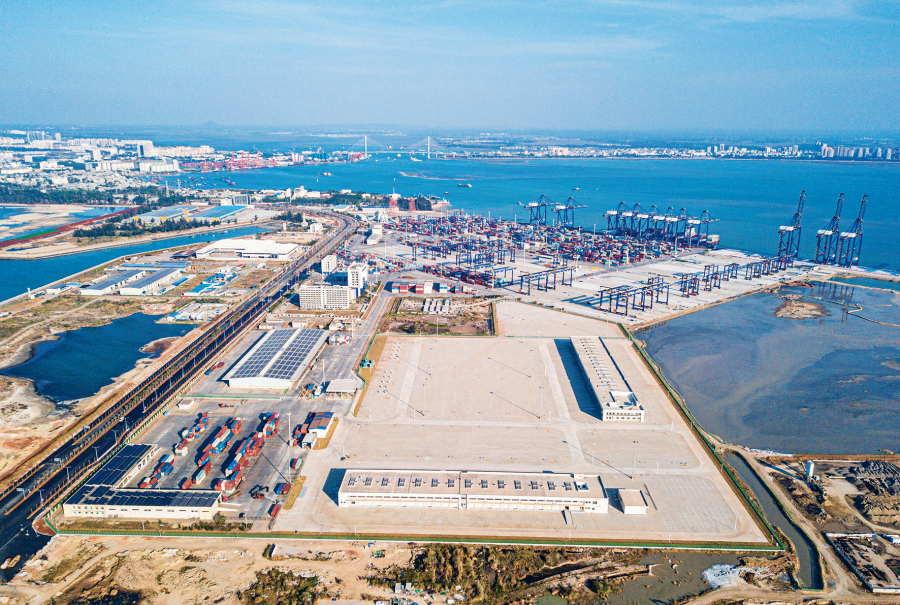
Facilities for the special customs operations at Yangpu Port, Yangpu Economic Development Zone, Hainan Province, January 12, 2025. At its fourth plenary session, the 20th CPC Central Committee laid out important plans for expanding high-standard opening up. The special customs operations initiative stands as a landmark measure in developing the Hainan Free Trade Port into an important gateway for China’s opening up. PHOTO BY XINHUA REPORTER PU XIAOXU
Despite facing headwinds, economic globalization remains an unstoppable historic force, and it will continue to drive flows of goods and capital, advances in technology and culture, and people-to-people exchanges between different countries. All this will create valuable opportunities for China to further expand high-standard opening up, attract and pool global resources and production factors, deepen trade, investment, and financial cooperation with other countries, develop its network of free trade zones, safeguard the global system of free trade, expand its global network of partnerships, and facilitate smooth flows between the domestic and international economies. Beyond this, continued global economic sluggishness can further highlight China's role as a stabilizing force, while profound structural shifts in the international division of labor will create opportunities to develop international industrial and supply chains in which China plays a central role.
As breakthroughs accelerate in the new round of technological revolution and industrial transformation, the world is entering a period of intensive sci-tech innovation. Advances are characterized by the convergence and integration of multiple technologies, driving collective leaps forward. Innovations are becoming markedly more penetrating, diffusive, and disruptive in nature, while the pace of industrial application has quickened. In fields like integrated circuits, artificial intelligence, quantum technology, biotechnology, new energy, and advanced materials, technologies are being rapidly upgraded and applied in integrated ways. China has established early-mover advantages across several sectors and boasts a diverse range of application scenarios, as well as vast market potential for new technologies. All this makes it well-placed to seize the initiative in technological and industrial development.
With the global governance deficit deepening and related public goods in short supply, our world has reached a critical juncture in global governance where we must either move forward or risk losing the progress we have so far made. If we are to address the various global challenges and pressing issues we face, we must take urgent action to reform and improve the global governance system. President Xi Jinping has proposed the vision of a community with a shared future for humanity, along with the Global Development Initiative, the Global Security Initiative, the Global Civilizations Initiative, and the Global Governance Initiative. These initiatives, which point the way forward for humanity and reflect the common aspirations of all peoples, have gained increasing traction because they capture the greatest common interests that unite our world. Such Chinese ideas and solutions have contributed both stability and momentum to global governance. Moreover, they have given China a stronger voice in global affairs while guiding the development of the international order in a more just and equitable direction.
On the other hand, however, China also faces numerous external risks and challenges.
Global security issues have grown more pronounced, with threats becoming increasingly interconnected, transnational, and diverse. Geopolitical conflicts flare up all too easily and frequently, fueling greater turbulence. Regional conflicts, such as those between Russia and Ukraine, and between Israel and Palestine, tend to persist and generate spillover effects, triggering energy and resource crises, threats to strategic corridors, food shortages, and large-scale refugee flows. Such problems have transcended regional boundaries to become common challenges for all humanity. As trust erodes among nuclear powers, strategic security threats are mounting, raising the specter of a new arms race. The growing fragility of strategic security mechanisms has made it more difficult to develop the strategic architecture needed to maintain common security and promote positive interactions. As traditional and non-traditional security threats compound, the security environment in China's neighboring regions is becoming increasingly complex.
Unilateralism and protectionism are on the rise, and industrial and supply chains are becoming more localized, regionalized, and bloc-based. The politicization and securitization of economic issues have become more prevalent, eroding the gains of globalization. More troubling still, hegemony and power politics pose growing threats, as the law of the jungle makes a return. The United States has recklessly launched tariff and trade wars that violate the legitimate rights of countries worldwide, as well as the rules of the World Trade Organization. Its actions have undermined the multilateral free trade system, severely harmed the stability of the global economic order, seriously impeded the course of normal economic and trade cooperation between China and the US, and hindered normal economic exchanges between China and other countries.
Major-country rivalry is now more intricate and intense than ever. A small number of Western countries, locked in a Cold War mentality and zero-sum thinking, believe that China is their primary strategic competitor. They have worked to fully encircle, suppress, and contain it, taking measures to build “small yards and high fences,” and carry out “decoupling and delinking.” Moreover, they have attempted to stoke bloc confrontation, engaged in information and cognitive warfare, and conducted ideological infiltration, in an attempt to slow or even derail China's modernization. All this has created growing external pressure for our country.
II. China’s numerous development strengths
During the 14th Five-Year Plan period (2021-2025), the CPC Central Committee with Xi Jinping at its core has united the entire Party and all the Chinese people and led them in meeting difficulties head-on and forging ahead with determination. This has enabled us to secure significant new achievements in the cause of our Party and country. With China reaching new heights in economic strength, scientific and technological capability, and composite national strength, we have made solid new strides in advancing Chinese modernization. As we look to the next five years, the Chinese economy has a solid foundation, great strengths in many areas, strong resilience, and huge potential. The conditions for and underlying trend of long-term growth remain unchanged. In concrete terms, China enjoys numerous development strengths, including but not limited to the following.
The system of socialism with Chinese characteristics
Our strengths in this regard are evident in multiple respects. Most notable, however, is the leadership of the CPC. The authority and centralized, unified leadership of the CPC Central Committee ensure that the Party’s guidelines, principles, and policies are implemented effectively across all levels, and that the Party leads the people in realizing established goals through sustained efforts. The CPC’s innovative theories provide sound guidance for major decisions, ensuring that economic and social development policies and measures adhere to objective laws. In our efforts to drive development, deepen reform, and maintain stability, leading officials at all levels play an exemplary role, primary-level Party organizations serve as critical pillars, and Party members function as vanguards.

Visitors view MetaX’s general-purpose C600 GPU on the opening day of the 2025 World Artificial Intelligence Conference, Shanghai, July 26, 2025. The conference showcased over 3,000 cutting-edge exhibits, with over 100 products making their world or China debut. During the 14th Five-Year Plan period, China has pursued greater self-reliance and strength in science and technology, making solid strides in sci-tech innovation. PHOTO BY CNS REPORTER TIAN YUHAO
The strengths of our system are also apparent in our ability to pool resources for major undertakings. We are able to expedite breakthroughs in core technologies in key fields and in basic and cutting-edge research projects by mobilizing China’s strategic scientific and technological resources. We have the capacity to pool quality resources across various sectors for the implementation of major strategies, projects, and initiatives that help drive broader economic and social development. We can formulate and implement macroeconomic policies tailored to specific circumstances, and make countercyclical and cross-cyclical adjustments to ensure these policies remain well-targeted and effective. This system also gives us the ability to swiftly and effectively respond to natural disasters and serious public emergencies, minimizing the loss of life and property.
The way we combine an effective market with a well-functioning government is also a notable strength of our system. By fully harnessing the decisive role of the market in allocating resources and ensuring the government plays its role effectively, we have created an economic order defined by both market vitality and effective regulation. Another strength is our system's capacity for self-improvement and self-development. By further deepening all-round reform, we have injected momentum and vitality into economic and social development and created strong institutional safeguards.
An enormous market
Given their enormous potential and room for growth, consumption and investment both represent sources of endogenous momentum for sustained and healthy economic and social development.
On the consumption side, China has a population of over 1.4 billion and a vast middle-income group. Public demand concerning education, healthcare, eldercare, childcare, and other wellbeing needs continues to increase, while people's diverse needs for a higher quality of life are steadily expanding. All of this is engendering immense potential for consumption. Meanwhile, steady personal income growth and the accelerated development of a unified national market are playing a powerful role in unleashing this consumption potential.
On the investment side, significant opportunities exist for building new infrastructure; upgrading traditional infrastructure and transforming it with digital and intelligent technologies; driving industrial iteration and upgrading; advancing new urbanization and vigorously implementing urban renewal; better coordinating regional development, boosting interconnected development between regions, and giving play to the role of key regions as growth poles; and accelerating the creation of a new development model for the real estate sector and building more houses that are safe, comfortable, eco-friendly, and smart. All this will help create much broader space for investment. Furthermore, in line with our commitments to both the public and non-public sectors, we will ensure full implementation of the Private Sector Promotion Law to further invigorate private investment.
A complete industrial system
Since the launch of reform and opening up in 1978, and especially the start of the new era in 2012, China's modern industrial system has enjoyed rapid development. Our agricultural foundations have been steadily strengthened, traditional industries have undergone transformation and upgrading, strategic emerging industries have flourished, industries of the future have been systematically developed, and modern services have grown rapidly. This has gradually given rise to a modern industrial system that is comprehensive, well-equipped, and highly coordinated.
Notably, China is the only country in the world to possess all industrial classifications designated by the United Nations, with 41 major, 207 medium, and 666 minor categories. Of the world's over 500 major industrial products, China ranks first globally in the output of more than 220. Our manufacturing sector has led the world in terms of overall scale for 15 consecutive years. Our comprehensive industrial system has bolstered the resilience of industrial and supply chains, further unleashed the potential of industrial development, reinforced the foundations of the real economy, and strengthened safeguards for economic security.
Abundant human resources
Since the 18th CPC National Congress held in 2012, major achievements have been made in human resource development. Our talent pool has expanded rapidly, its performance has continued to improve, and our comparative advantage in this domain has been further strengthened. China now possesses a vast, well-structured pool of high-caliber talent that is playing an ever more prominent role in our development. By the end of 2024, China's pool of skilled professionals had expanded to 220 million people. Our country has had the world's largest cohort of R&D personnel for many years. It is also home to over 72 million highly skilled workers, making it the world's largest and most comprehensive hub of talent resources.
Chinese universities produce over five million STEM graduates each year, the highest number globally. In key and core technology fields, China has created a large pool of scientists and technologists with strategically important expertise, along with first-class scientists and innovation teams. A cohort of outstanding entrepreneurial leaders in enterprise operations and management has also emerged. In 2024, the share of Chinese citizens with scientific literacy reached 15.37%, marking a leap from a comparatively low level to the middle tier. This wealth of human resources is helping turn China's demographic dividend into a talent dividend and providing a steady supply of innovation and creativity for economic and social development.
At the same time, we must remain aware that the imbalances and inadequacies in our development are still pronounced. Effective demand is sluggish, and bottlenecks and obstacles are impeding economic flows. The task of transitioning to new growth drivers remains formidable, and agricultural and rural modernization is lagging behind. There is considerable pressure weighing on employment and personal income growth, and gaps and weak links still exist in our work to ensure public wellbeing. Changes in China's demographic structure pose new challenges for economic development and social governance, and risks and hidden dangers persist in some key areas. It is essential that these problems are addressed and resolved through development.
III. Opening up new horizons by proactively identifying, responding to, and steering changes
Based on an in-depth analysis of the international and domestic landscapes, the Recommendations lays out the guiding philosophy, core principles, main objectives, major strategies, and policies and measures for economic and social development over the next five years. To seize the strategic initiative amid intense international competition, foster new opportunities amid crises, and break new ground on a shifting landscape, we must above all focus on managing our own affairs well.
Maintaining strategic resolve
History evolves according to its own internal laws; its course is not subject to human will. Peace, development, cooperation, and mutual benefit remain the defining trends of our times, and it is a historical inevitability that justice will prevail over evil, light over darkness, and progress over reaction. We have every reason to be confident of success: we have always stood on the right side of history and on the side of human progress, and we have moved forward in harmony with the logic of history and the development trends of our times, all of which firmly place us in a position of moral strength. We are now following an irreversible course toward national rejuvenation; we have the CPC Central Committee led by Xi Jinping at the helm to chart our course; we have the sound guidance of Xi Jinping Thought on Socialism with Chinese Characteristics for a New Era; and China's development is underpinned by a host of strengths that are growing in prominence.
It is important that we take the long view and develop the ability to look beyond the surface to the essence of issues. We should never let trivial details distract us or cloud our vision, and never allow others to dictate our pace. Drawing on the Recommendations, analysis of China's development environment during the 15th Five-Year Plan period, we must accurately observe and grasp the currents of our times, advance in line with evolving circumstances and trends, and turn crises and challenges into opportunities, in a bid to seize the initiative. We should learn from history and draw on practice by effectively summarizing and applying the CPC's experience of confronting risks, meeting challenges, and withstanding pressure in the more than 100 years since its founding, especially since the start of the new era. To ensure we are never swayed by risks or interference, we must become more mindful of potential dangers and prepare for worst-case scenarios. We need to anticipate developments and plan to act accordingly so that we remain undaunted by formidable challenges. It is vital that we pursue our goals with relentless hard work and dedication and remain confident even in the face of turbulence.
Forging broad unity
As circumstances grow more complex, challenges become more grave, and tasks turn more demanding, it becomes all the more important to harness our collective wisdom and strength, tap into the innovative and creative vitality of our hundreds of millions of people, and generate a mighty force for inspiring all Chinese people to work in concert to advance our great cause. To this end, we must actively develop whole-process people's democracy, respect the people's principal role and pioneering spirit, protect their rights to equal participation and development, and work to create a vibrant environment where all people strive for progress, meet their responsibilities, and fulfill their potential. Adhering to our Party's mass line for the new era, we must accurately grasp the contemporary features of society—including the emergence of new social groups, the diversification of interests, demands, ideas, and values, and the digitalization of social interactions—in order to make our work with the public more relevant and effective. We must actively respond to public issues, focus on resolving the pressing difficulties and problems that concern people most, and work continuously to give people a stronger sense of gain, happiness, and security.
To build on the results of our study campaign for fully implementing the central Party leadership's eight-point decision on improving work conduct, we must make unremitting efforts to tackle pointless formalities, bureaucratism, hedonism, and extravagance. We need to foster new practices, cultivate a political atmosphere of integrity, and win the people's support with further improvements in Party conduct. We also should see to it that our Party becomes better at providing political leadership and theoretical guidance, organizing the people, and inspiring society.
Having the courage and competence to carry forward our struggle
In a period marked by opportunities and challenges, as well as growing uncertainties and unforeseen factors, it is important to maintain high morale and firm determination and cultivate a strong will and capacity to strive for our cause. Only by doing so can we seize the initiative and remain invincible amid high winds, choppy waters, and even dangerous storms. In the face of external containment, suppression, and pressure, we must have the fortitude to resist oppression and stand up to hegemony. We must never yield on core interests, compromise on matters of principle, or retreat in the face of threats and coercion. China's sovereignty, security, and development interests must be resolutely defended. When it comes to international disputes and regional hotspot issues, we must determine our position and policies based on the merits of each issue itself and firmly oppose hegemonic, bullying, and coercive practices.
To address challenges in economic and social development—particularly deep-rooted issues—we need to adopt entirely new approaches and reform measures. We need to coordinate the implementation of comprehensive solutions and continue advancing reform in order to tackle longstanding ills and fully resolve entrenched issues. Our efforts should also be focused on consolidating and expanding our strengths, removing development bottlenecks, and shoring up areas of weakness.
To address prominent problems within our Party, we must have the resolve and tenacity to persist in the always-ongoing endeavor of self-governance. This requires us to turn the blade inward in a spirit of self-reform. We must firmly address any signs of slackening resolve, fatigue, or retreat in the face of problems and exercise rigorous governance to reinforce our foundations, conduct oversight of officials, strengthen primary-level organizations, improve conduct, and tighten discipline. We must be determined to win the tough, protracted, and all-out battle against corruption and act swiftly to eliminate any virus that threatens the health of our Party.
Resolutely advancing toward our goals
With the blueprint for the 15th Five-Year Plan period now in place, the critical task is implementation. We should fully leverage the strategic guidance of the Recommendations and see that its guiding principles are applied in formulating national and local 15th five-year plans, along with sector-specific plans. We should improve the monitoring, evaluation, and oversight of plan implementation and refine the mechanisms for policy coordination and work collaboration, so as to uphold the integrity and authority of plans, improve our capacity for implementation, and ensure that the Party Central Committee's decisions and plans are carried out in full.
The Recommendations, guiding principles should be reflected in all major development decisions and the concrete steps we take to advance development. With a firm commitment to our goals, major tasks, and key priorities, we must drive coordinated progress across all sectors. We must promote higher-quality economic growth while achieving an appropriate increase in economic output, make solid headway in advancing well-rounded personal development and common prosperity for all, and secure decisive progress toward basically realizing socialist modernization.
(Originally appeared in Qiushi Journal, Chinese edition, No. 21, 2025)