


Exclusive Interview | Advancing Reform for the Market-Based Allocation of Production Factors


- Share


Editor’s Note: Reforms to advance the market-based allocation of production factors are integral to both building a unified national market and developing a high-standard socialist market economy. In September 2025, the State Council issued its Approval of the Implementation Plan for Comprehensive Pilot Reforms to Promote the Market-based Allocation of Production Factors in Selected Regions Nationwide. This marked the launch of pilot programs in 10 regions around China and set out a blueprint for implementing this reform. More recently, at its fourth plenary session, the 20th Central Committee of the Communist Party of China (CPC) laid out strategic plans to “accelerate improvements to the institutions and mechanisms for the market-based allocation of production factors.” To explore how we should understand and advance these reforms, Qiushi reporter Hou Yajing conducted an exclusive interview with Xu Shanchang, president of the China Society of Macroeconomics; Fan Xin, vice dean of the School of Economics of Renmin University of China; and Liu Peilin, chief researcher at Tsinghua University’s Academic Center for Chinese Economic Practice and Thinking.
Reporter: The efficiency of production factor allocation has a direct bearing on a country’s economic endowment and development dynamism. Could you please elaborate on the background and significance of China’s deepening reform for the market-based allocation of production factors in the current context?
Fan Xin: Economic development hinges on improving the efficiency with which resources are allocated, particularly scarce resources. The aim is to produce as many products as possible and deliver maximum benefits while minimizing resource inputs. In the early days of reform and opening up, China began introducing market mechanisms in order to unleash and develop productive forces, thereby gradually establishing a system of commodity markets. As reforms advanced, market mechanisms played an increasingly important role in resource allocation, particularly after the CPC set the goal of establishing a socialist market economy at its 14th National Congress held in 1992. As a result, prices for a wide range of goods and services came to be determined by the market, and the focus of reform gradually extended from commodity markets to factor markets.
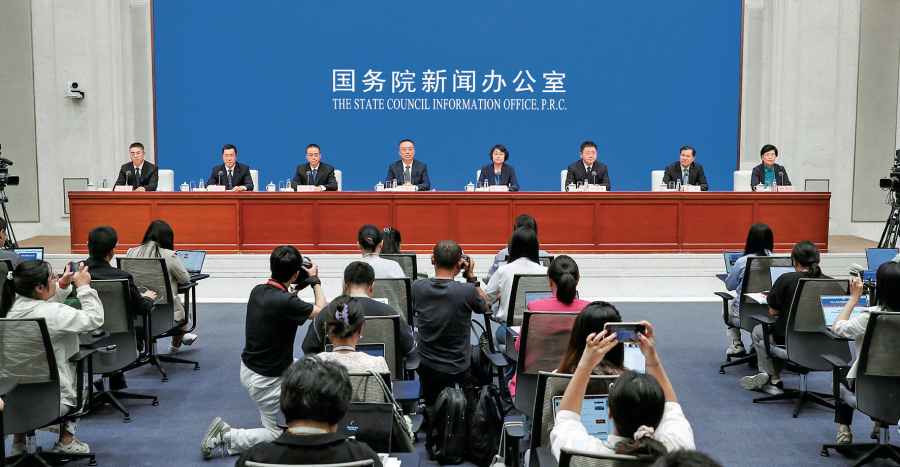
Officials brief reporters and answer questions on the implementation of comprehensive pilot reforms to promote the market-based allocation of production factors in selected regions nationwide at a State Council Information Office policy briefing in Beijing, September 11, 2025. XINHUA / PHOTO BY LIU JIAN
Since entering the new era in 2012, with the continual improvement of China’s socialist market economy, marketization has been advanced substantially, and the macro regulatory system has become much more robust. Yet issues remain. This includes a relatively underdeveloped factor market, which, at a deeper level, has weighed on the overall efficiency of the national economy. Now that China has entered a stage of high-quality development, deepening reforms for the market-based allocation of production factors will help break down local protectionism and market segmentation. Beyond this, they will help accelerate the development of a high-standard socialist market economy by further boosting and unleashing the potential of our vast market, promoting smooth domestic economic flows, and strengthening the endogenous drivers and innovative vitality underpinning growth.
Xu Shanchang: At a strategic level, the reform for market-based factor allocation is a major national development initiative and a top priority for the CPC Central Committee and the State Council. At present, rolling out this comprehensive pilot reform is a key task on the agenda for further deepening comprehensive reform, as it directly addresses several pressing practical needs.
First, we need to address structural imbalances. The traditional development model, driven by government direction and factor inputs, has indeed delivered many years of rapid economic growth, but it has also allowed deep-seated structural problems to accumulate. These issues are most clearly reflected in mismatches between supply and demand, sluggish industrial upgrading, and weak impetus for innovation. The root cause of these issues lies in serious distortions in how production factors and resources are allocated. By piloting reforms that let the market play the decisive role in allocating resources, production factors can be steered away from low-quality, inefficient sectors to high-quality, efficient ones. This shift will help fundamentally address deep-seated problems in economic development and promote the sound and steady growth of the economy.
Second, we need to cultivate new quality productive forces. We need to create new factor allocation approaches, as this is crucial for promoting the development and innovation of new quality productive forces. By piloting reforms to eliminate bottlenecks that impede the development of new quality productive forces, we can see that production factors are channeled toward such forces and ensure they are allocated to promote their development. Over time, this will give rise to more advanced productive forces and more competitive production models.
Third, we need to address rat race competition in a holistic way. We have seen such competition leading to severe internal friction in some localities in recent years. It has given rise to serious resource waste and low return on factor inputs. All of this has suppressed vitality for innovation and resulted in wrong price signals that have failed to faithfully reflect market supply and demand. By piloting reforms to remove choke points affecting market entry and exit, allocation of production factors and resources, and other issues, we can resolve the problem of fragmented and balkanized economic flows and markets at the local level, thereby fundamentally removing the breeding grounds for this kind of competition.
Reporter: What are the problems China currently faces in the market-based allocation of production factors, and what are the underlying causes of these issues?
Liu Peilin: Although China’s factor markets have indeed experienced rapid development in recent years, they are still hindered by several prominent challenges. Compared to the markets for goods and services, market-based allocation of production factors remains relatively limited, while institutional and systemic barriers impede the orderly flow of factors. How these challenges manifest varies from sector to sector. In terms of land, pilot programs allowing rural collective land designated for business-related construction to enter the market have yet to be extended nationwide, and the mechanisms governing the transfer and circulation of urban land remain quite convoluted.
In terms of labor, the free movement of human resources is still constrained by the household registration system as well as social security, education, and healthcare issues. From the perspective of capital, administrative institutions continue to play an outsized role in allocation, leaving business entities of different sizes and with various ownership structures unable to secure financing on market-determined terms. For new types of production factors, such as technology and data, we lack adequate market rules and well-defined property rights, while trading systems and platforms require further improvement.
Xu Shanchang: For many years, China’s factor markets have been hampered by administrative boundaries and dominated by local interests. This has resulted in regional authorities imposing their own restrictions on production factors, such as land, labor, and technology. Despite repeated prohibitions, local protectionism and market segmentation have persisted, impeding the free flow of factors across regions and administrative levels. Compounding these problems are incomplete institutional rules and underdeveloped evaluation and incentive mechanisms.
For example, the lack of unified standards for valuing and trading key production factors, such as land, technology, and data, has hindered many innovation outcomes from realizing their full market value. In addition, despite ongoing capital market reforms, market access criteria still vary across regions and industries, and financial resources are not allocated efficiently.
Fan Xin: At a deeper level, the cause of these issues lies in the blurred boundaries between the government and the market. For example, some local governments attempt to take charge of all facets of economic development, undermining normal market operations. Similarly, in certain sectors and regions, officials abuse their administrative discretion and enforce the law unevenly, often resulting in arbitrary charges, fines, and inspections. When local governments act improperly, they prevent the societal-wide free flow and optimal allocation of production factors and resources. This breeds redundant, low-quality development and rat race competition, and ultimately makes it impossible to maximize the efficiency and overall returns of resource allocation. Therefore, deepening reform for the market-based allocation of production factors hinges on striking the right balance between an effective market and a well-functioning government. We must both respect and give full play to the market’s decisive role in resource allocation, while also ensuring the government fulfills its role more effectively. In doing so, we can fully unleash the dynamism of various types of production factors, ensuring they are combined in efficient ways and flow smoothly.
Reporter: As a new wave of technological revolution and industrial transformation gathers pace, we are facing new developments and tasks in reforms to advance the market-based allocation of production factors. What new opportunities will this latest round of comprehensive pilot reforms open up?
Xu Shanchang: Deepening reforms to promote the market-based allocation of production factors—particularly by pioneering new approaches through comprehensive pilot programs—will help unlock a wealth of opportunities for economic and social development by boosting coordination among production factors. First, these reforms will accelerate the development of new quality productive forces. In this round of pilot reforms, we are focusing on institutional innovation in the areas of technology, data, computing power, and human resources. The aim is to foster virtuous cycles between education, science and technology, and talent, and between science and technology, industry, and finance, so that we can see scientific and technological advances moving more swiftly from laboratories to production lines. Second, they will drive innovation and industrial upgrading. These pilot programs include reforms designed to put production factors such as land, capital, and labor to best use. This means channeling more resources into spheres such as advanced manufacturing and green, low-carbon industries. At the same time, these programs can also help spawn new forms and models of business by promoting market-based flows of production factors such as data, carbon emission rights, and ecological products. Third, they will help strengthen confidence for economic development and future growth. By unifying institutions and rules, strengthening property rights protection, and improving trading platforms, these pilot reforms will help foster a market environment more conducive to fair competition, which will significantly boost the confidence of all market entities and spur greater private capital investment in innovation and entrepreneurship.
Liu Peilin: On the whole, this round of comprehensive pilot reforms is not just a major move aimed at tackling deep-seated problems in factor markets; it is also a systematic endeavor designed to advance the development of a unified national market and a high-standard socialist market economy. As such, the pilot reforms will provide powerful momentum for high-quality development and help elevate it to a new level. I must also emphasize that these comprehensive pilot reforms to make factor allocation more market-based are closely aligned with the requirement to steadily advance institutional opening up. Some of the exploratory measures being pursued, such as facilitating cross-border receipts and payments, supporting the development of international technology transfer platforms, developing new methods for regulating cross-border data flows, and broadening recognition for overseas professional qualifications, are all integral to high-standard opening up.
Reporter: Building unified markets for production factors and resources is a key step in our efforts to develop a unified national market. How, then, should we understand what these markets entail?
Liu Peilin: The endeavor to build unified markets for production factors and resources nationwide is aimed at putting in place a fair, open, transparent, and efficient framework of rules and institutions for factor markets, so as to reduce resource misallocation, waste, and idle capacity. These efforts are primarily focused on five dimensions.
First, a unified set of rules for defining property rights must be established. The principles and legal basis for determining ownership of any given type of production factor should be uniform nationwide, regardless of the region, form of ownership, sector, or size of the owner in question. Second, a unified set of conditions should be applied for market entry and exit. With the guidance of price signals, owners of production factors should be able to deploy factors freely across regions and industries, different ownership structures, and entities of different sizes. Third, unified mechanisms for price discovery and trading need to be put in place. All production factors of a given type should be traded through nationally unified trading systems and platforms, so that a single, consistent market price is created. Fourth, unified regulatory rules must be adopted. Regulators should apply the same scope of oversight and the same standards to determine whether transactions involving a given type of production factor are regulatorily compliant or if they involve unfair competition or monopolistic practices. Fifth, the rules governing returns generated from production factors must be unified. Production factors of the same kind should be accorded the same rights and command the same price.
Xu Shanchang: Unified markets for production factors and resources are essential for advancing the development of a unified national market. The comprehensive pilot reform being rolled out across ten regions represents a landmark initiative for accelerating the development of unified markets for factors and resources. China has a huge economy and an enormous domestic market. However, if factor and resource markets remain fragmented, the advantages of our vast market will be seriously undermined.
By building unified factor and resource markets, we can let market rules, prices, and competition guide allocation. In doing so, we can address key questions about where labor should flow, where capital should be invested, and where technology should be deployed. By channeling resources from less efficient sectors to more productive ones, we can boost the operational efficiency and resilience of the national economy. Moreover, creating nationally unified factor and resource markets will help eliminate local protectionism and unfair competition. This is crucial for unlocking consumption potential, expanding the space for investment, and unleashing innovation vitality.

Exhibitors discuss smart city practices with a visitor on the opening day of the China International Big Data Industry Expo 2025 in Guiyang, Guizhou Province, August 28, 2025. Themed “Data Drives Industrial Momentum, Intelligence Unlocks the Future,” the expo showcased the latest achievements in integrating AI technology with data as a production factor. PHOTO BY XINHUA REPORTER TAO LIANG
Reporter: Pilot programs serve as both a key entry point for breakthroughs and a testing ground for driving reform and addressing deep-seated challenges. What strategic considerations were involved in choosing the ten regions selected to carry out comprehensive pilot reforms for the market-based allocation of production factors?
Xu Shanchang: Specifically, these comprehensive pilot reforms will be carried out in ten regions: Beijing’s municipal administrative center; key cities in southern Jiangsu Province; the Hangzhou-Ningbo-Wenzhou area in Zhejiang Province; the Hefei metropolitan area in Anhui Province; the Fuzhou-Xiamen-Quanzhou area in Fujian Province; Zhengzhou in Henan Province; the Changsha-Zhuzhou-Xiangtan city cluster in Hunan Province; the nine mainland cities of the Guangdong-Hong Kong-Macao Greater Bay Area; Chongqing Municipality; and Chengdu in Sichuan Province. This configuration has been carefully designed in line with our country’s regional development strategy and each region’s resource endowments and level of development. It is intended to facilitate differentiated explorations based on the distinctive features of each area.
These ten regions possess solid development foundations and a strong capacity to drive broader growth. In 2024, they accounted for more than one-quarter of China’s total economic output. They also span several major strategic areas, including the Beijing-Tianjin-Hebei region, the Yangtze River Delta, the Guangdong-Hong Kong-Macao Greater Bay Area, and the Chengdu-Chongqing economic zone. As such, they form a representative cross-section covering eastern, central, and western China. Conducting pilot programs in these regions will help us address the common difficulties hindering cross-regional flows of production factors, while also facilitating efforts to remove bottlenecks in factor flows within and between city clusters. They will provide solid support for the push to accelerate the development of a unified national market and promote smooth flows in the domestic economy.
Fan Xin: Looking at the implementation plans of the ten regions, it is clear that each region has placed a keen focus on its local conditions and distinctive strengths to identify the key areas and specific tasks for these reforms. This approach will enable regions to build on their respective factor endowments to develop unique advantages, cultivate differentiated growth poles, and promote coordinated regional development. For example, in the Hangzhou-Ningbo-Wenzhou area, efforts will be focused on strengthening the capacity for independent innovation. This will involve planning and developing scientific facilities and jointly undertaking major national science and technology projects. The nine mainland cities of the Guangdong-Hong Kong-Macao Greater Bay Area will receive support to lead the way in applying intelligent, unmanned multi-domain systems across land, sea, and air, and in developing relevant standards. In the Hefei metropolitan area, the Anhui Provincial Data Exchange will be leveraged as a hub to drive the circulation and trading of data.
This round of comprehensive pilot reforms has been tailored to both national needs and the respective strengths of the regions involved. This will allow us to fully tap the drive and initiative of regions for exploring new ground and gradually give rise to best practices that can be replicated and applied nationwide.
Reporter: The comprehensive pilot reform covers not only traditional production factors, such as land, labor, and capital, but also new types of factors, such as technology and data. How should we understand the relationship between these two? And how can we ensure they are allocated in a more coordinated way on all fronts?
Fan Xin: The notion of what constitutes a production factor is not set in stone. Over time, technology and data have emerged as new production factors, gaining increasing prominence alongside the traditional pillars of land, labor, and capital. China’s development experience shows that traditional and emerging production factors are not locked in a mutually exclusive, either-or relationship. Instead, they coexist in a dynamic equilibrium, working in synergy and amplifying each other’s value. On the one hand, new production factors will not replace traditional ones. To develop and expand new quality productive forces, we must rely on traditional factors such as land, labor, and capital, as well as growing contributions from new factors such as technology and data. On the other hand, traditional production factors are far from backward. When empowered by digital and intelligent technologies, their full potential can be unlocked, enabling a transformative leap from low-efficiency use to high-value output. This will provide essential support for the application of new types of production factors.
Liu Peilin: New quality productive forces are defined by cutting-edge technology, high efficiency, and superior quality. A central hallmark of these forces is their capacity to drive significant gains in total factor productivity, which essentially measures how effectively production factors are combined. These kinds of efficiency gains can only be realized by promoting the mobility and reallocation of production factors. When it comes to coordinating production factor allocation, the priority should be ensuring that all types of factors can be seamlessly integrated, dynamically matched, and allowed to flow efficiently. Overall efficiency gains in this regard will ensure the support needed for developing new quality productive forces.
First, we need to underscore the systemic, holistic, and coordinated nature of reform. Different reform measures should align with and reinforce one another to advance the market-based allocation of production factors across all sectors. Second, greater attention should be paid to market-based allocation in key sectors. With comprehensive pilot reforms as a major driver, regions should be encouraged to steadily optimize allocation mechanisms through differentiated approaches. Third, we must move faster to establish sound allocation structures and service support mechanisms tailored to the development of new quality productive forces. In particular, we need to develop clear allocation channels for new types of production factors and put in place stronger guarantees to ensure production factors for new forms of business and new sectors.
Xu Shanchang: To allocate production factors in a more efficient and coordinated way and accelerate the development of new quality productive forces, we need to advance reform and innovation across several areas.
First, we need to move quickly to establish mechanisms for defining property rights over various production factors, so as to create the conditions for smooth market entry and exit and enable production factors to be combined to optimal effect. Second, we need to strengthen the mechanisms for property rights protection and pricing. We should refine the policies for incentivizing intellectual property protection and the mechanisms for benefit-sharing, while also establishing a unified mechanism for pricing. Third, we should enhance the mechanisms for ensuring the coordinated provision of production factors. We need to promote mutual recognition of professional qualifications, sharing of technologies, and integration of data as a production factor, while also developing incentives to steer production factors toward advanced industries. Finally, we should redouble efforts in the areas of monitoring, evaluation, and institutional innovation. We need to put in place a comprehensive system to monitor the performance of factor markets, conduct timely assessments of pilot reform outcomes, and take systematic steps to replicate and apply proven practices.
Reporter: The reform to advance market-based factor allocation has now entered a pivotal stage. In light of the goals and requirements for Chinese modernization, could you please outline the primary avenues for deepening this reform?
Xu Shanchang: Chinese modernization has reached a stage where simply stacking production factors is no longer enough to sustain high-quality economic and social development. To enhance the overall efficiency of market-based factor allocation, we must promote systemic integration and coordinated efficiency. First, to improve coordination and efficiency, we must enable new types of production factors to interact and integrate with traditional ones. This means eliminating bottlenecks in the chains linking science and technology, industry, and finance, as well as those connecting data, computing power, and algorithms. Our aim should be to achieve networked sharing, systematic integration, and coordinated use for all production factor types. Second, we need to improve the mechanisms for production factor pricing and returns. By ensuring production factors are largely priced on the basis of market supply and demand, we can guard against undue government interference in price formation. To truly unlock the dynamism of production factors, we must ensure that their contributions are determined by the market and rewarded accordingly. Third, we need to build a production factor market that is unified, well-regulated, secure, and risk-resilient. This requires developing robust trading platforms and regulatory frameworks, with a view to modernizing factor-market governance. We also need to strengthen our risk prevention and control efforts to ensure resilience and security in key domains.
Fan Xin: Deepening reform for market-based factor allocation is a long-term, systemic endeavor—one that demands sustained efforts and a commitment to securing progress while maintaining stability. Our focus should be on two key tasks—clearing bottlenecks and reinforcing safeguards—so as to ensure solid support and build institutional strengths for advancing Chinese modernization. To remove institutional bottlenecks, we must dismantle the administrative and regional barriers that impede the free flow of production factors and address market weaknesses that prevent their coordinated, efficient allocation. By markedly enhancing the efficiency of allocation, we can unleash fresh momentum and vitality for high-quality economic development. To ensure more coordinated regulation, we must refine the rules governing transactions in production factor markets and improve the regulatory framework. We must see that the government plays a more effective role in setting rules, conducting market oversight, and providing public services. This will enable us to foster a sound environment where production factors flow freely and are traded on equitable terms.
Reporter: I would like to thank each of the three experts for taking the time to share your insights.
(Originally appeared in Qiushi Journal, Chinese edition, No. 22, 2025)