

Improving the Modern Integrated Transportation System


- Share


The Recommendations of the Central Committee of the Communist Party of China for Formulating the 15th Five-Year Plan for National Economic and Social Development, adopted at the fourth plenary session of the 20th Central Committee of the Communist Party of China (CPC), proposes “improving the modern integrated transportation system, strengthening cross-regional coordination and planning, promoting multi-modal integration, and improving transportation links and services in remote areas.” This strategic directive by the CPC Central Committee, aimed at building a great country and advancing national rejuvenation through Chinese modernization, reflects a profound understanding of the significant role of transportation development.
I. Fully understanding the significance of improving the modern integrated transportation system
President Xi Jinping attaches great importance to building a modern integrated transportation system and has repeatedly made important directives emphasizing the need to create a modern transportation network, strengthen connectivity and coordination to improve efficiency, and accelerate the formation of a comprehensive transportation system that is safe, convenient, efficient, green, and economical. We must fully comprehend and learn from these directives and effectively heighten our sense of responsibility and urgency in improving the modern integrated transportation system.
1. Improving the modern integrated transportation system is a strategic task for ensuring transport modernization serves and safeguards Chinese modernization
Transportation is at the forefront of China’s modernization. Since the founding of the People’s Republic of China in 1949, generations have carved out roads through mountains and bridged rivers, driving our development of transportation to world-renowned achievements: the world’s largest high-speed rail and expressway networks, the largest postal and courier network, and a number of world-class port clusters. The quality and efficiency of comprehensive transport services have steadily improved, fundamentally removing transportation bottlenecks on the national economy, better meeting the needs of economic and social development, and establishing China as a major power in transportation. During the 14th Five-Year Plan period (2021-2025), the main framework of the national transport network structured around “six axes, seven corridors, and eight channels” exceeded 90% completion, which laid a solid foundation for boosting China’s strength in transportation and represented a breakthrough in the development of the integrated transportation system. The 15th Five-Year Plan period (2026-2030) will be critical in the process as we work to reinforce the foundations and push ahead toward basically realizing socialist modernization. We must seize the opportunity in accelerating the improvement of a modern integrated transportation system, further enhancing transport’s overall capacity, service quality, and operational efficiency, and supporting the decisive progress already made toward basically achieving socialist modernization.
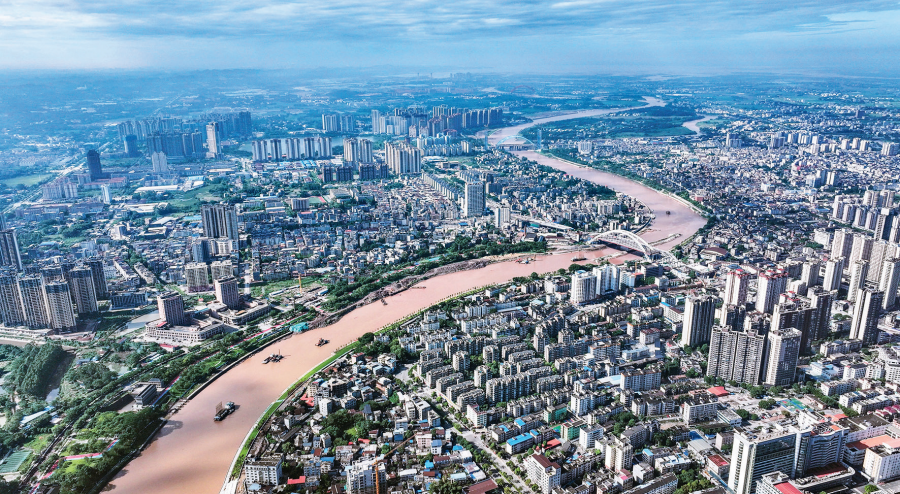
A section of the Pinglu Canal under construction in Qinzhou City, Guangxi Zhuang Autonomous Region, August 24, 2025. The canal is a backbone project of the New International Land-Sea Trade Corridor in western China as well as a landmark project designed to boost China’s strength in transportation. PHOTO BY XINHUA REPORTER ZHANG AILIN
2. Improving the modern integrated transportation system is the foundational support for strengthening the domestic economy and fostering a new development dynamic
Transport connects production with consumption, and links domestic and international markets, spanning the entire chain from production to distribution and consumption. It serves as essential support for smooth economic flow. During the 14th Five-Year Plan period, the composition of the transportation sector underwent deep adjustment while services became more economical and efficient. In 2024, transport costs were reduced by approximately RMB 280 billion, demonstrating notable results in cutting costs and improving quality and efficiency. At the same time, we must recognize that transport still faces problems of unbalanced and insufficient development: the comprehensive transport network continues to suffer from structural deficiencies; multi-modal connections do not function as smoothly as possible; the composition of the transportation sector still calls for further optimization; facility safety standards require improvement; and building a unified, open transport market remains a long-term demanding task. We must accurately understand the complex and profound changes in China's development environment during the 15th Five-Year Plan period in order to balance domestic and international imperatives, improve the modern integrated transportation system, further strengthen cross-regional planning and multi-modal integration, establish a diversified and resilient system of international transport channels, and accelerate the formation of a safe, efficient and well-connected inbound and outbound logistics network, thus better strengthening the domestic economy and promoting unimpeded domestic and international economic flows.
3. Improving the modern integrated transportation system is an important measure for cultivating new quality productive forces and promoting high-quality development
Transport is a technology-integrated, application-driven industry with vast market scale and abundant application scenarios. It is a key field for developing new quality productive forces and an important area for quickly boosting China's strength in science and technology. In recent years, China has substantially enhanced its technological capabilities in transportation infrastructure construction, achieving major breakthroughs in emerging transport vehicles such as intelligent connected vehicles, large cruise ships, smart ships, and large aircraft, while also leading the world in technologies including intelligent high-speed rail, intelligent roads, and automated terminals. During the 15th Five-Year Plan period, breakthroughs will accelerate in the new round of technological revolution and industrial transformation. Seizing the opportunity to cultivate new quality productive forces is crucial to accelerating China's transportation strength. We must improve the modern integrated transportation system, accelerate the innovative application of artificial intelligence in transportation, strive to make breakthroughs in core technologies in key fields, coordinate the integrated development of education, science and technology, and talent, and hasten the formation of new driving forces and new advantages to better advance transportation modernization.
4. Improving the modern integrated transportation system is essential for meeting the people’s aspirations for a better life and promoting common prosperity for all
Transport is closely tied to the national economy and people's livelihoods. As a critical sector affecting the public livelihood and a foundational safeguard for achieving common prosperity for all, the sector has, in recent years, followed the principle of “transportation for the people.” It has accelerated the development of transportation that meets people's needs and advanced the construction of high-quality rural roads that are well-built, well-managed, well-maintained, and well-operated. Where conditions permit, all towns, townships, and villages have been connected to paved roads as well as buses and postal services. This has provided strong support for poverty alleviation and effective rural revitalization. In the 15th Five-Year Plan period, the trend toward coordinated regional development and integrated urban-rural development will become more evident, with urban agglomerations and metropolitan areas showing increasingly diverse travel needs. Transportation support in rural and remote areas will be raised to higher standards. To improve the modern integrated transportation system, we must further strengthen regional and urban-rural connectivity, bolster coverage and accessibility in weak areas, and effectively narrow the development gaps in transportation across regions, between urban and rural areas, and among different groups. This will provide a solid guarantee for advancing common prosperity for all.
II. Gaining a precise grasp of the overall requirements for improving the modern integrated transportation system
The Plan for Developing China's Strength in Transportation and the Plan for the National Integrated Multi-Dimensional Transport Network, issued by the CPC Central Committee and the State Council, set the goal of making significant ground in fundamentally enhancing strength in transportation by 2035 and, by the middle of this century, fully establishing a world-leading transportation system that satisfies the people and provides robust guarantees. During the 14th Five-Year Plan period, under the strong leadership of the CPC Central Committee with Xi Jinping at its core, China has made accelerated progress in strengthening its transportation system. The promising vision that “people enjoy mobility and goods flow smoothly” is also advancing toward realization at a faster pace.
The 15th Five-Year Plan period is a crucial stage for achieving the strategic goal of boosting China's strength in transportation. We must thoroughly implement the CPC Central Committee's decisions and policies. In this process, high-quality development serves as the central theme; the improvement of the modern integrated transportation system is the main focus; and integration, intelligent upgrading, green transformation, and safety enhancement stand as the key paths forward. Driven fundamentally by reform and innovation, we will spare no effort to build first-class infrastructure, technology, management, and services and promote decisive progress toward the goal of boosting China's strength in transportation, thereby providing stronger transport services and guarantees for basically achieving socialist modernization.
In improving the modern integrated transportation system, we should focus on the following four principles. First, we should serve the overall situation and the people. We should fully leverage transportation's leading role in China's modernization and continuously strengthen its capacity to support economic and social development and major national strategies. We should adhere to a people-centered approach, continuously improve the capacity of transportation to guarantee and enhance people’s livelihoods, and better promote common prosperity for all. Second, we should holistically coordinate and pursue integrated development. We must apply systems thinking to optimize the layout, structure, functions, and system integration of the overall transportation network, and optimize the allocation of new resources while making best use of existing ones, thus raising the overall efficiency of the transportation system. Third, we should deepen reform and drive innovation. We will utilize comprehensive reform of transportation system as the guiding factor to remove institutional barriers that impede high-quality development in transportation. We will accelerate research and development and deployment of new technologies, lead the development of new quality productive forces through technological innovation, and promote greater efficiency, expanded capabilities, and stronger momentum in transportation. Fourth, we should view transportation as a global concern and pursue openness and cooperation, seeking to advance the joint creation of a high-quality integrated multidi-mensional transport network under the Belt and Road Initiative, actively participate in global transport governance, and create new space for development through high-standard opening up, thus treading a path of open cooperation and mutual benefit.
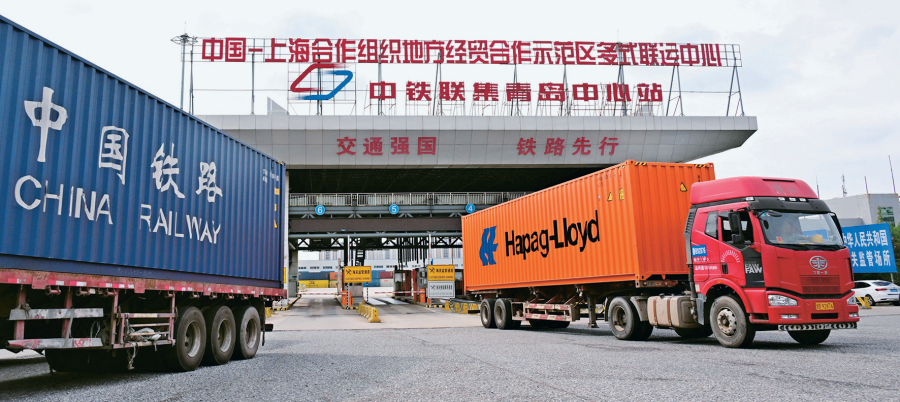
Freight trucks depart from the multi-modal transportation center at the China-SCO Local Economic and Trade Cooperation Demonstration Area, Qingdao, Shandong Province, August 27, 2025. Accelerating the development of multimodal transport is vital for reducing costs, boosting quality, and improving efficiency in transportation and logistics. It is also essential for building a modernized, comprehensive transportation system. PHOTO BY XINHUA REPORTER LI ZIHENG
Efforts to improve the modern integrated transportation system should emphasize the following four priorities. First, we should place greater emphasis on integrated development. This includes strengthening deep integration across different modes, regions, sectors, and industries, further optimizing and adjusting the structure of the transportation network, enhancing coordination and connectivity, advancing coordinated planning, and expanding room for development. Second, we must place greater emphasis on intelligent upgrading. To this end, we will promote increased application of new technologies, such as big data, the Internet, artificial intelligence, and blockchain, in the transportation sector to continuously create new drivers of development. Third, we must place greater emphasis on the industry’s green transition. We will implement carbon peak and carbon neutrality goals, strengthen the conservation and intensive use of resources and production factors, promote low-carbon and energy-saving facilities and equipment, enhance environmental protection and pollution prevention, and strive to elevate green development in transport. Fourth, we must place greater emphasis on improving safety. We must ensure both development and security, improve the resilience of the transport network system, strengthen safety and emergency guarantees, ensure safe and stable transport operation, and effectively enhance the capacity to safeguard national security and social stability.
III. Implementing all major tasks to develop the modern integrated transportation system
The CPC Central Committee has made it an explicit requirement that we must secure major breakthroughs in strategic tasks of overall importance to Chinese modernization during the 15th Five-Year Plan period. During this period, we must consolidate and build on our strengths, remove development bottlenecks, shore up areas of weakness, and enhance quality and performance so as to basically establish the modern integrated transportation system.
1. Accelerating development of modern transportation infrastructure
We should strengthen transportation infrastructure planning by optimizing its layout and structure, promoting integrated development, and working to ensure that infrastructure is safer and more resilient. First, we will make greater efforts to develop a national comprehensive and multi-dimensional transportation network, which entails advancing the construction of major corridors between regions and across river basins and working faster to connect the “six axes, seven corridors, and eight channels.” We will launch the inland waterway transportation connectivity project and accelerate the formation of a high-speed railway network supported by a backbone of eight north-south and eight east-west main corridors and connected by regional high-speed railways. A new round of initiatives to further upgrade rural roads will also be launched. Second, we will make greater efforts to develop comprehensive transport hubs. We will further develop international comprehensive transportation hub clusters in the Beijing-Tianjin-Hebei region, the Yangtze River Delta, the Guangdong-Hong Kong-Macao Greater Bay Area, and the Chengdu-Chongqing economic zone. We will advance the development of national port hub systems, national integrated airport systems, and national postal and express delivery hubs. Efforts will be made to develop comprehensive transportation hub cities and optimize their layout, so as to enhance the agglomeration and spillover effects they provide. Third, we will make greater efforts to improve the quality and efficiency of the development of the comprehensive transportation network. We will strengthen the interconnectivity of transportation infrastructure. We will improve the national comprehensive multi-dimensional transportation network, in which railways serve as the backbone, highways as the foundation, and the comparative strengths of waterway and civil aviation transportation are fully leveraged. We will promote the upgrading and digital-intelligent transformation of existing transportation infrastructure and promote the integrated development of transportation infrastructure networks, transport service networks, information networks, and energy networks.
2. Accelerating development of the modern transportation service system
We should expand diversified transport services and enhance the capacity of service guarantees so as to ensure the gains of transportation development benefit all our people in a fair way. First, we must provide more convenient travel services. We will accelerate the development of cross-city transportation in metropolitan areas, launch projects to increase the efficiency of intercity commuting within metropolitan areas, and develop diversified public transport tailored to local conditions. We will actively promote “single-ticket” systems to facilitate integrated passenger transport. We will advance integrated urban-rural transportation development and strengthen the development and renovation of age-friendly and barrier-free facilities. Second, we must further reduce costs and improve quality and efficiency in transportation and logistics. We will deepen adjustment to the transport mix, vigorously develop multimodal transport, promote the use of single bill of lading and container-through transport systems, and accelerate the development of a new generation of integrated logistics service providers. We will vigorously develop modern shipping services, improve the international logistics supply chain system, and strengthen rail freight transportation between China and Europe and between China and other parts of Asia. Third, we will actively and prudently promote the development of new forms of business in transportation. We will promote integrated development of transportation with tourism, energy, and postal services, develop the low-altitude civil aviation sector according to local conditions, and improve car rental networks. We will also accelerate the integrated development of passenger, freight, and postal services in rural areas.
3. Accelerating development of a modern system for transport equipment and technology
It is necessary that we foster and develop new quality productive forces to improve the system of scientific and technological innovation leading the modernization of transportation. First, we will push for more breakthroughs in core technologies in key fields. Focusing on smart, integrated, and multi-dimensional transportation, we will launch major scientific and technological projects, advance research and development in generic technologies, such as those for infrastructure and transport equipment, and carry out a number of major innovation projects. Second, we will vigorously develop smart transportation. We will promote cross-sector integration of cutting-edge technologies, including artificial intelligence, new-generation information technology, big data, and aerospace information with transportation, while implementing the “AI+Transportation” initiative. Third, we will advance the integration of scientific and technological innovation with industrial innovation. We will promote the development of strategic emerging industries in transportation, including high-end equipment manufacturing, new-energy vehicles and vessels, new materials, energy conservation, environmental protection, and information technology. We will also accelerate the cultivation and development of smart logistics, a low-carbon economy, and digital transportation industries. Fourth, we will promote the green and low-carbon transition of transportation. We will actively promote the adoption of clean and low-carbon transport vehicles and equipment, such as new-energy vehicles and vessels, and establish cross-regional zero-emission freight corridors and green shipping corridors.
4. Accelerating development of the modern transportation governance system
We will continuously improve the capacity and standards for industry governance, so as to promote positive synergy between high-quality development and greater security through high-efficiency governance. First, we will further advance comprehensive reforms in the transportation sector, including advancing reform of the integrated transportation system, continued optimization of toll road policies, and deeper reform for coordinated administrative law enforcement in transportation. Second, we will build a unified and open transportation market. We will improve new credit-based regulatory mechanisms, abolish regulations and practices that impede the development of a unified national market and fair competition, and address rat race competition in transportation. Third, we will refine our transportation laws, regulations, and standards. We will promote the formulation and revision of the transportation law, railway law, maritime law, port law, as well as the toll road management regulations, regulations on international maritime transport, road transport regulations, and other laws and regulations. Fourth, we will make every effort to ensure industry safety and stability in the transportation sector. We will intensify safety regulation in key areas, improve the intrinsic safety of infrastructure, enhance disaster prevention, mitigation, and relief capabilities, and strengthen emergency response capacity for major incidents, effectively curbing serious accidents. We will advance the development of modern national defense transportation and earnestly safeguard the rights and interests of people engaged in new forms of employment in transportation.
(Originally appeared in Qiushi Journal, Chinese edition, No. 21, 2025)