


Accelerating the Development of a Modern Water Network


- Share


The fourth plenary session of the 20th Central Committee of the Communist Party of China (CPC) adopted the Recommendations of the Central Committee of the Communist Party of China for Formulating the 15th Five-Year Plan for National Economic and Social Development (hereinafter referred to as the “Recommendations”), which points out that we should accelerate the development of a modern water network and enhance our capacity to prevent floods, coordinate the allocation of water resources, and ensure water supply in both urban and rural areas. This represents a major plan made by the Central Committee with the aim of raising the level of national water network development.
I. Understanding the significance of accelerating the development of a modern water network
Since the 18th CPC National Congress held in 2012, President Xi Jinping has approached the sustainable development of the Chinese nation from a holistic, strategic perspective. He has personally planned and promoted the development of the national water network, visiting project sites frequently, presiding over several meetings to study and make arrangements, and producing a series of important expositions and directives. He has emphasized that upon completion of the water network, we will have achieved another milestone in China's water conservation history, a feat which will be inscribed in the annals of time. To advance Chinese modernization, we must take water resources into consideration. As we enter a new stage of development, apply the new development philosophy, and foster a new pattern of development, water resources will provide strong support for building a unified national market, ensuring unimpeded domestic economic flows, and promoting coordinated development between the north and the south. We must remain attentive to the complex and profound impacts of global climate change, respond proactively from the perspective of prioritizing safety, and comprehensively enhance disaster prevention and control capabilities to safeguard people's lives. A modern water network is a foundational, strategic, and pioneering public facility and service system of the country, which plays a crucial role in coordinating flood control, water resources, aquatic ecosystems, and aquatic environments. Therefore, it is essential to safeguarding China's water security and advancing Chinese modernization.
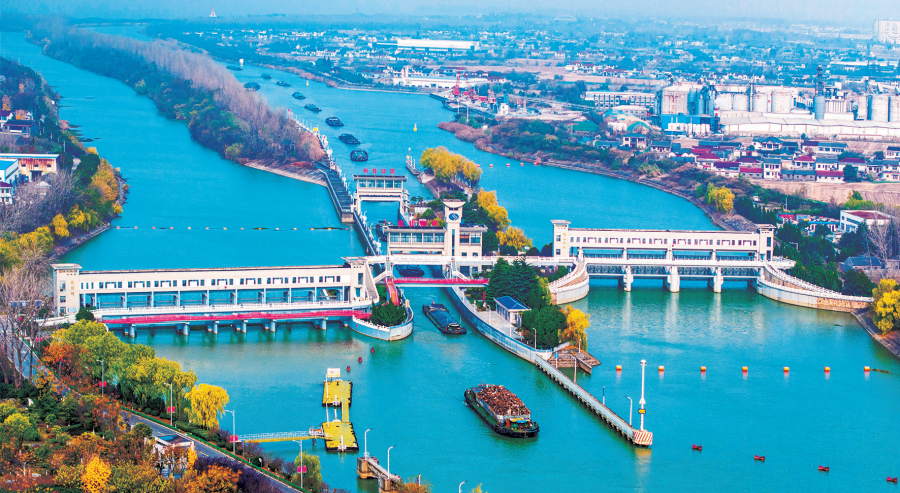
The Yunyan Sluice, Shaoxian Ship Lock, and Shaoxian Sluice opening on Phase I of the Eastern Route of the South-to-North Water Diversion Project, Jiangdu District, Yangzhou, Jiangsu Province, December 13, 2024. During the 15th Five-Year Plan period, China will work quickly to advance the high-quality development of follow-up projects of the South-to-North Water Diversion Project. This will see it accelerating the construction of backbone water transmission and distribution channels and key water storage and regulation nodes, in order to optimize the allocation of water resources (drone photo). XINHUA / PHOTO BY ZHOU SHEGEN
1. The imperatives of advancing Chinese modernization
President Xi has stated that water security is important for the long-term stability of the country. China's basic water conditions have long been characterized by summer floods and winter droughts, with a north-south regional imbalance in the availability of water resources. The intrinsic characteristics of China's unique natural climate and geography, the mismatch between the spatial-temporal distribution of water resources and the layout of economic and social development, the ongoing process of ecological advancement, the intensifying impact of global climate change, and frequent extreme floods and droughts are all factors that determine water security risks remain a prominent challenge in the process of Chinese modernization. The period covered by the 15th Five-Year Plan from 2026 to 2030 will be critical as we work to reinforce the foundations and push ahead toward basically realizing socialist modernization by 2035. There is an urgent need to strengthen the capacity for water resources regulation and supply, improve flood risk prevention and response, and enhance ecological protection and governance of rivers. We must accelerate the development of a modern water network, adopt a forward-looking approach, work ahead of schedule as appropriate, optimize supply and properly allocate resources, and fully leverage the advantages and comprehensive performance of a super-large-scale water network system, so as to better meet the people's growing needs for a better life, facilitate high-quality economic and social development, and promote harmony between humanity and nature. All of these efforts will provide comprehensive support for Chinese modernization.
2. The supply of the water conservancy infrastructure system
After years of persistent effort, especially during the 14th Five-Year Plan period (2021-2025), construction began on a large number of long-term major water conservancy projects that are of overarching and strategic importance. The layout, structure, and functions of China's water conservancy infrastructure system have been further improved. China now has established the largest water conservancy infrastructure network in the world, operating with the most complete range of functions and benefiting the largest population. It has effectively ensured flood control, water supply, food security, and ecological security. However, we must be clearly aware that the water conservancy infrastructure network still faces systemic weaknesses, applies standards that are not yet high enough, and suffers from gaps in connectivity and integration of water conservancy projects. Public service quality and efficiency must also be improved. We must reinforce our foundations, address weak links, and foster greater strengths to accelerate the development of a modern water network. By enhancing the strength of scale, service capacity, and demand adaptability of the network, we will develop a high-quality, high-standard water network with great resilience, and better leverage its overall effectiveness and comprehensive performance, so as to ensure a higher level of water security.
3. The development trend of the infrastructure system
Currently, the environment and conditions for infrastructure development are undergoing profound and complex changes. A new round of technological revolution and industrial transformation is picking up the pace, with breakthroughs in frontier technologies emerging and technological innovations surging unprecedentedly. The modes of investment, operation, and management for infrastructure are accelerating transformation and upgrading. In response to new circumstances and trends, it is urgent that we better leverage scientific and technological innovation as a leading and driving force, reshape established concepts, promote technological transformation, and create new models, thus upgrading the water network to achieve a higher standard, a stronger foundation, a more robust guarantee, and more optimized functions. We must accelerate the development of a modern water network, promote application of emerging technologies at all stages and in all dimensions of the construction and operation of the water network, and foster safe, green, integrated, and smart development of the water network.
II. Key features of the modern water network
1. Systematic and complete
A comprehensive and systematic water network should be established to integrate key functions including water resources allocation and utilization, basin-wide flood control and drainage, and the protection of aquatic ecosystems. This kind of integrated system encompasses the key national water network as well as provincial, municipal, and county-level water networks. It will not only ensure water security for major economic zones, city clusters, energy bases, grain-producing areas, and ecosystem service zones through optimal, macro-level resource allocation, but also extend to remote areas including small and medium-sized rivers, rural water bodies, irrigation districts, and villages, delivering high-quality public water services.
2. Secure and reliable
Focusing on ensuring both high-quality development and greater security, we should establish a comprehensive monitoring and sensing system featuring full coverage, full element integration, round-the-clock operation, and lifecycle management. We should put in place a robust management framework grounded in sound institutions and mechanisms, legal provisions, and clearly defined responsibilities. Furthermore, an effective system for identifying, assessing, and addressing risks and hazards should be developed, complemented by a precise set of measures encompassing forecasting, early warning, simulation, and contingency planning. These coordinated initiatives will collectively strengthen the security and reliability of the water network, enabling it to fully perform its functions and maintain systemic stability in the face of evolving environments characterized by functional concentration and accumulating risks.
3. Intensive and efficient
In accordance with the fundamental principles governing strategic water conservancy projects, which emphasize necessity, ecological security, and sustainability, and guided by the overarching framework of integrated basin management and balanced spatial allocation of water resources, we should systematically coordinate the relationships between water resources development and conservation, existing and new resources, temporal and spatial distribution, as well as investment and returns. The planning and construction of water conservancy projects should be advanced in a well-conceived manner, with strategic emphasis placed on strengthening connectivity and weak links. Through optimizing the layout, structure, functions, and system integration of these projects, the overall effectiveness of the super-large-scale water network will be fully leveraged, so as to enhance the intensive and secure utilization of water resources and achieve an integrated balance of economic, social, ecological, and security benefits.
4. Eco-friendly and smart
We should stay committed to advancing both high-quality development and high-standard environmental protection, and uphold the principles of prioritizing ecological conservation and pursuing green development. By respecting objective laws and conducting rigorous evaluation of project proposals, we should ensure that the planning, construction, and operation of water network projects fully demonstrate the principle of harmony between humanity and nature. We should adhere to the guiding principles of prioritizing water conservation before water diversion, pollution control before water transfer, and environmental protection before water use. Full consideration should be given to the carrying capacity of water resources within river basins and regions, designating water availability as a determining factor in urban and industrial development, agriculture, and population distribution. Digital twin technology should be applied to achieve comprehensive digital mapping and intelligent simulation of all engineering attributes as well as operation and management processes of the water network, fostering deep interaction and bidirectional coupling between physical and digital water networks. This integration will enable comprehensive monitoring and sensing, intelligent data analysis and prediction, as well as forward-looking decision-making support, thereby driving the lifecycle transformation of water network projects toward digital, internet-based, and smart-tech models.
5. Integrated and unimpeded
By taking major rivers, lakes, and other natural water systems, key water diversion projects, and important conveyance and drainage channels as the “main strands”; regional river-lake connectivity projects and water supply channels as “meshes”; and strategically located and functionally critical water storage and regulation facilities as the “nodes”; we should establish an integrated water network that links the key national water network with provincial, municipal, and county-level water networks. This integrated structure will enable coordinated water allocation across wet and dry periods, ensure orderly water circulation, and significantly enhance capabilities in flood discharge, drainage, water conveyance, and resource recycling.
6. Orderly and regulated
We should work to achieve unified, coordinated, and precise management of all levels of the water network. Within the digital flow field, coordination and operating schemes for each water network project will be dynamically simulated and iteratively optimized using a “forward-inverse-forward” process. Water flows will also be proactively stored, regulated, and allocated to realize Pareto optimality in multi-objective coordination encompassing flood control, water supply, irrigation, hydropower generation, navigation, and ecological conservation.
III. Key tasks for accelerating the development of a modern water network
The CPC Central Committee and the State Council have issued the Outline for the Development of the National Water Network and set forth objectives and tasks for developing the national water network. During the 15th Five-Year Plan period, it is essential to thoroughly study and implement President Xi’s approach to water governance of prioritizing water conservation, balancing spatial distribution of water resources, conducting systematic governance, and leveraging the strengths of both the government and the market. By focusing on key priorities in addressing critical issues, we will accelerate the development of a modern water network.
1. Developing a system of flood prevention and disaster mitigation projects on the basis of river basins
By viewing river basins as a whole and focusing on major rivers and lakes, we will work to further optimize the layout of flood prevention and disaster mitigation projects. Through the integration of expanding drainage capacity, increasing storage, and controlling risks, we will establish a basin-based modern flood control system comprising reservoirs, river channels, levees, and flood detention basins and raise the standards for flood prevention projects so as to ensure flood control of key cities, economic zones, and infrastructure. We will build a three-line defense system for monitoring and forecasting of rainfall and water regime, which consists of meteorological satellites and rainfall radar networks, rainfall monitoring gauge networks, and hydrological station networks. These three lines will be interconnected, operate progressively, and function collaboratively to extend flood forecast lead times while also improving the accuracy of forecast, thereby providing precise rainfall and water regime information to support flood regulation and control.
2. Developing an inter-basin, cross-regional system for allocating water resources and securing water supplies
By analyzing long-term trends in water supply and demand, regional distribution, and structural characteristics, we will coordinate the synergistic construction of the key national water network with provincial, municipal, and county-level networks. We will accelerate the high-quality development of follow-up projects of the South-to-North Water Diversion Project as well as the construction of backbone water transmission and distribution channels and major water storage and regulation nodes to optimize the overall pattern of water resources allocation. Efforts will be made to modernize and renovate irrigation areas and enhance farmland irrigation and drainage projects to ensure food security and the stable, safe supply of major agricultural products. We will promote the “3+1” model for standardized construction and management, including the integration of urban and rural water supply, the scaling-up of centralized water supply, the standardization of small-scale water supply, and the specialization of county-level unified management. This will ensure that rural water supply transitions from a focus on basic availability to safe and reliable drinking water.
3. Developing an aquatic ecosystem protection and governance system focusing on ecologically vulnerable areas
We will revitalize the ecological environment of rivers and lakes and implement whole-basin ecological protection and governance spanning from the source of a river through to its estuaries. We will intensify our efforts to address unauthorized occupation, mining, dumping, and construction within rivers, lakes, and reservoirs in accordance with the law and establish green ecological corridors along rivers, so as to restore life to rivers and revitalize basins. We will strictly enforce the control over both total volume of groundwater extraction and water levels and take comprehensive measures to address overextraction of groundwater in major regions, including north China and the water-receiving areas of the South-to-North Water Diversion Project. We will strengthen water source conservation and protection in river headwaters and intensify soil erosion control in key areas. Monitoring and protection of water sources and areas along the routes of great water diversion projects will also be reinforced.
4. Developing a digital twin water network that carries out forecasting, early warning, simulation, and contingency planning
As we persist in adhering to the principles of responding to demand, prioritizing practical application, promoting digital and intelligent empowerment, and striving to enhance capabilities, we will improve the layout of monitoring networks for hydrology, water resources, and water conservancy projects in line with the requirements for coverage of all relevant elements, high precision and frequency, and continuity, and establish an integrated monitoring and sensing system covering space, air, ground, water, and engineering works. We will set up a digital twin platform and employ a hydraulic-specialized mathematical modeling system based on mechanism analysis and understanding of the underlying pattern, as well as mathematical statistics and data mining technologies. We will conduct high-fidelity simulations under changing flow field conditions to achieve the accumulation and analysis of historical data, synchronous interaction of real-time data, and prediction and simulation of future scenarios. This will provide forward-looking, scientific, precise, and safe decision-making support for the operation and management of the water network.
IV. Striving to realize the grand blueprint of developing a modern water network
The construction of a modern water network is a complex, long-term task. As we set our sights on achieving this goal, we must make persistent efforts to turn the grand blueprint of developing a modern water network drawn up by President Xi and the CPC Central Committee into a reality step by step.
1. Strengthening organization and implementation
We should uphold and strengthen the CPC's overall leadership and implement the working mechanism under which the central leadership makes overarching plans, provincial authorities assume overall responsibility, and city and county authorities take charge of implementation. By adopting a holistic approach and region-specific policies, we should promote overall planning and coordinated development of water network projects at all levels in a well-conceived and systematic manner in light of local economic and social development as well as resource and environmental conditions. As we work to ensure that the objectives and tasks set forth in the Recommendations are fully accomplished, we must also focus on carrying out the development goals for the year 2035 laid out in the Outline for the Development of the National Water Network. We should expand project reserves and enhance policy support, improve preliminary feasibility studies for future projects, and set appropriate and reasonable scales, layouts, and plans for their construction. All of these efforts will ensure steady and sustained progress in developing a modern water network.
2. Enhancing scientific and technological support
We should actively carry out research on major issues concerning the construction and operation of a modern water network, promote breakthroughs in core technologies, and advance the R&D of equipment and the application of new achievements. The capacity for scientific research in developing a national water network should be enhanced and relevant research centers should be established. We should accelerate talent cultivation and practical training within this sector and nurture top-notch scientists and professional innovation teams, so as to develop a strong workforce for the construction of a modern water network.
3. Further advancing reform and innovation
Leveraging the role of both the government and the market, we should actively explore a management model for promoting the integration of investment, construction, and operation, raise funds for construction through multiple channels, and encourage private capital to participate in the construction and operation of water network projects by means of equity cooperation, franchised operation, and public-private partnership. Eligible projects are supported in carrying out trials of real estate investment trusts (REITs) for infrastructure to put idle assets to better use. We should accelerate the development of coordination and big data centers for the national water network. We should promote pricing reforms for water supplies, refine the system for the market-based trading of water-use rights, and improve the efficiency and effectiveness of the operation of the water network. Regular mechanisms for the operation, management, and maintenance of the water network should also be refined to ensure long-term, sound operation.
(Originally appeared in Qiushi Journal, Chinese edition, No. 22, 2025)