Qi Opera: Ancient local drama


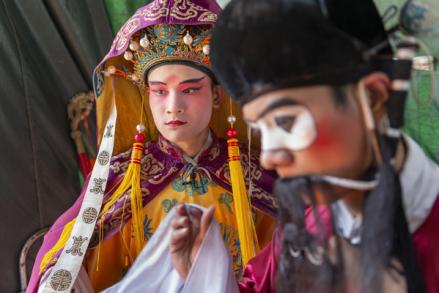
Qi Opera performers grace the stage in elaborate costumes and intricate makeup. [Photo provided to chinadaily.com.cn]
Qi Opera, the most widely performed and historically significant traditional opera in Central China's Hunan province, boasts a history of over 500 years, making it far older than Peking Opera.
The art form remains vibrant today, particularly in Hunan cities like Yongzhou, Hengyang, and Chenzhou. In 2008, Qi Opera was inscribed on the second list of China's national intangible cultural heritage items.
Qi Opera originated from the Yiyang tune (one of the four great tunes from the Southern opera) and was introduced to Yongzhou during the early Ming Dynasty (1368-1644). Over time, it blended with local artistic traditions to create the gaoqiang (high-pitched tune) style.
As it evolved, Qi Opera incorporated elements from Kunqu Opera, the Zhi tone (one of the five ancient Chinese musical scales), and Han Opera, eventually developing three primary vocal styles: gaoqiang, tanqiang (a singing style features unaccompanied storytelling and the performance of instrumental pieces), and kunqiang (localised Kunqu vocal).
Recognized for its powerful, rugged vocal delivery, Qi Opera is characterized by rich musical textures and distinctive instruments such as the moon lute and the three-stringed lute. Performers emphasize vocal precision, blending true and falsetto tones to produce the opera's unique sound.
The opera features seven character types, including sheng (male roles), hualian (painted-face roles), and dan (female roles), each with its own set of specialized performance techniques.
In recent years, Qi Opera has seen breakthroughs in its preservation and innovation. The modern Qi Opera production One Picul of Silver Dollar earned the Tian Han Grand Award at the 8th Hunan Art Festival. By incorporating modern technology, this production has propelled Qi Opera into a new creative era.
Both seasoned performers and younger students are carrying forward the legacy of Qi Opera. Su Meirong, a student of the Yongzhou Qiyang Qi Opera Troupe, shared that while training is demanding, the satisfaction of seeing her progress on stage makes all the effort worthwhile. Qi Opera is now entering a promising new chapter of transmission and growth.