State Grid Jiangsu Electric Power Company: International and Domestic Experts Laud Yangzhou-Zhenjiang Direct Current (DC) Series Projects


"The Yangzhou-Zhenjiang DC project stands out not only as a model of technological breakthroughs and construction quality but also as a benchmark in the application of 'AC-to-DC' conversion and in supporting socio-economic development," said Professor Zhang Xiaoping on May 8.
Zhang is Chief Professor of Power Systems at the University of Birmingham, Co-Director of the Energy Research Institute, Chairman of the UK Branch of the Chinese Society for Electrical Engineering, IEEE Fellow, and IET Fellow.
"From its inception to execution, the project showcases China's robust capabilities in DC transmission technology. Moreover, it has optimized the existing power flow layout to achieve efficient regional energy allocation."
On the same day, the "Summary Meeting of the First Phase of the Yangzhou-Zhenjiang DC Project and the SLCC (Multi-Source Commutation DC Transmission Technology) Technical Seminar for the Second Phase" took place in Zhenjiang, Jiangsu Province. The event included a main conference (keynote forum) and three sub-conferences (sub-forums), focusing on the operational achievements of the first phase of the Yangzhou-Zhenjiang DC project, research and application of SLCC technology in the second phase, and exploring new power systems' development, green and low-carbon energy transformation, and DC transmission technology innovation. Over 160 representatives attended the conference, including Academician Shen Guorong from the Chinese Academy of Engineering, Vice Mayor Huang Chunnian of Zhenjiang, Senior Consultant Wang Zhiwei from the company, domestic and international university academicians and experts, university students, representatives of academic organizations, and members of the business community.
Academician Shen Guorong said, "State Grid Jiangsu Electric Power Co., Ltd. has achieved remarkable results in its innovative use of embedded DC for efficient power resource allocation within the region.
“The first phase of the Yangzhou-Zhenjiang DC project has set a national example in increasing grid transmission power, enhancing operational flexibility, and strengthening short-circuit current control. The construction of hybrid AC/DC grids can leverage DC transmission advantages for efficient power allocation while utilizing AC transmission technology for transmission and distribution across various voltage levels. This novel application of DC technology is worth exploring."
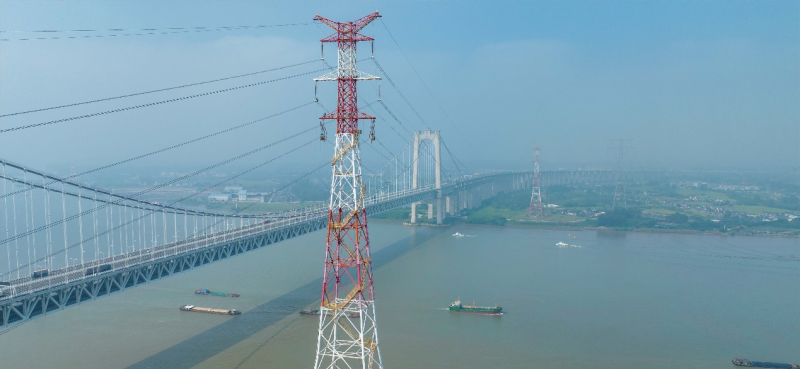
As China's inaugural "AC-to-DC" project, the first phase of the Yangzhou-Zhenjiang DC project commenced construction in December 2022 and became operational in April 2024. Since its launch, it has maintained safe and stable operations, transmitting over 6 billion kilowatt-hours of electricity, leading to over 50% of wind and solar power installations in the Yangzhou area and surpassing 50% clean energy consumption in the Zhenjiang area.
The first phase of the Yangzhou-Zhenjiang DC project closely interconnects Jiangsu Province's northern and southern grids. It can autonomously adjust operational modes from 0MW to the full 1,200MW power based on grid requirements. At present, considering the province's new energy generation scale and the structure of new energy installations in North Jiangsu, the project operates at 1,080–1,200MW during high photovoltaic (PV) power generation and 600–720MW during low PV power generation. It has played a pivotal role in ensuring grid connection and consumption of new energy sources like PV and wind power, significantly enhancing regional power transmission and mutual assistance capabilities. Within the first year of operation, the project has run for over 5,000 hours.

During the main conference, company representatives provided a briefing on planning and constructing hybrid AC/DC grids in Jiangsu. Professor Zhang Xiaoping presented his latest research findings on the duality theory of high-voltage DC transmission technology. Nari-Relays discussed the development and future prospects of key technologies for DC transmission control and protection. At the sub-conferences (sub-forums), experts and scholars from Zhejiang University, Southeast University, Beijing Jiaotong University, South China University of Technology, and Tianjin University showcased China's accomplishments in "flexible AC/DC transmission technology." Participants from the first and second phases of the Yangzhou-Zhenjiang DC project shared their experiences and insights on project planning, construction, and operation. State Grid Economic Research Institute, China Southern Power Grid Scientific Research Institute, and domestic advanced power equipment manufacturing enterprises presented breakthroughs in China's independent and controllable high-end power equipment in the realm of advanced AC/DC transmission equipment. Over 30 special reports were unveiled at the conference, highlighting the construction achievements of new power systems in Jiangsu and China from academic, construction, and equipment perspectives.
The second phase of the Yangzhou-Zhenjiang DC project is over halfway complete and is slated for DC system commissioning by early 2026. This phase will be the first to utilize China's independently developed multi-source commutation DC transmission technology (SLCC).
Professor Xu Zheng from Zhejiang University remarked, "SLCC combines LCC's large-capacity transmission with VSC's rapid reactive power independent control.
“It breaks away from traditional DC's rigid dependence on AC systems, enhances resistance to commutation failure, and comprehensively improves traditional DC transmission's grid-related characteristics and equipment safety, making it valuable for broader application and promotion."
In the future, the company plans to construct additional "embedded" DC projects, including the third phase of the Yangzhou-Zhenjiang DC project and the cross-river DC transmission project from Nantong to Suzhou. These projects will contribute more "Jiangsu solutions" to the integrated development of the Yangtze River Delta and the construction of new power systems, continuing to provide "Chinese solutions" for addressing challenges such as constrained transmission corridors and excessive short-circuit currents in grid development.