From neolithic sites to frontier poems: Guyuan's living legacy in Chinese history


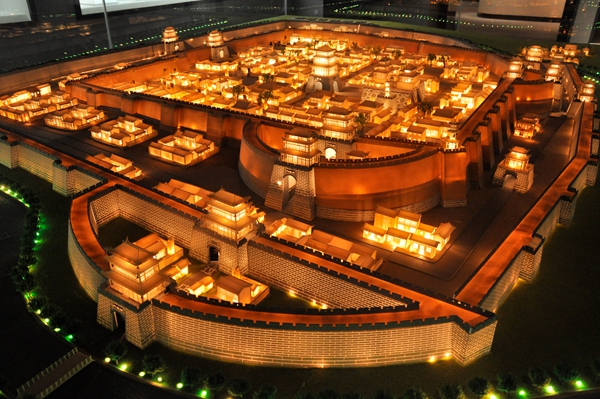
A model of Guyuan Ancient City. [Photo provided to chinadaily.com.cn]
Guyuan possesses an exceptionally rich historical and cultural legacy as one of the birthplaces of Chinese civilization. The region is home to the 30,000-year-old Ruhe Ling'er Paleolithic Site and over 500 Neolithic archaeological sites dating back 4,000 years, representing multiple significant prehistoric cultures including the Yangshao Culture, Majiayao Culture, Caiyuan Culture and Qijia Culture. These remarkable remains testify to Guyuan's crucial role in China's ancient cultural development.
Guyuan showcases a number of magnificent historical relics, including large-scale Yaobeiyuan Western Zhou Dynasty (c. 11th century-771 BC) ruins, the strategically vital Kaicheng Anxi Prince's Mansion military-administrative complex, and the frontier fortress of Guyuan Ancient City.
The region preserves the winding Warring States-era Qin Great Wall, the still-imposing Xiao Pass fortress, and the Northern Zhou-Sui-Tang Cultural Park demonstrating Chinese-Western cultural fusion.
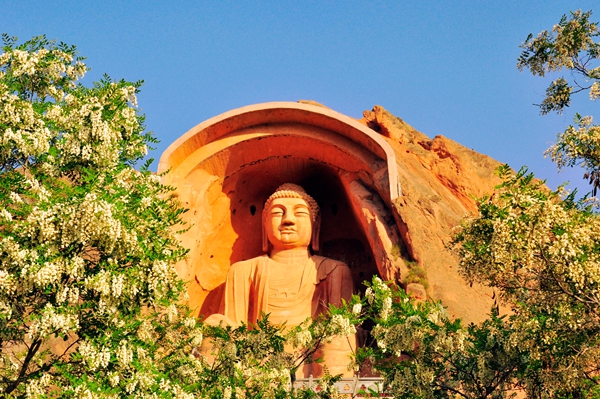
The Xumi Mountain Buddhist Grottoe. [Photo provided to chinadaily.com.cn]
Among its treasures shines the Silk Road gem — the Xumi Mountain Buddhist Grottoes, at whose feet lies a 200-meter section of the ancient Changliang Road that once served as the vital passage connecting the Hexi Corridor's four commanderies with Chang'an (modern Xi'an).
Guyuan is also home to the nationally renowned Guyuan Museum, a first-class national institution housing priceless cultural relics such as Northern Wei lacquered coffin paintings, a Northern Zhou gilded silver vase, and a glass bowl with raised dots.
This culturally fertile land also gave birth to China's earliest frontier poetry, with its influence evident in famous verses from the Book of Songs, establishing homesickness and patriotism as enduring themes that would resonate through generations of Chinese frontier poetry.