Echoes of time: Exploring Ningxia's memories from tombs to tillage


The Guyuan Museum of Ningxia is a national first-class and comprehensive provincial-level museum. Core exhibitions include "The Silk Road in Guyuan", "The Invisible General Han Liancheng","The Ancient Tomb Gallery", "The Stone Craving Gallery" and various temporary exhibitions. The museum houses over 20,000 cultural relics, including three national cultural relics and 123 national first-class cultural relics. Among them, the lacquered coffin painting from the Northern Wei Dynasty (AD 386-534), the gilded silver ewer from the Northern Zhou Dynasty (557-581), and the studded glass bowl are considered national treasures.
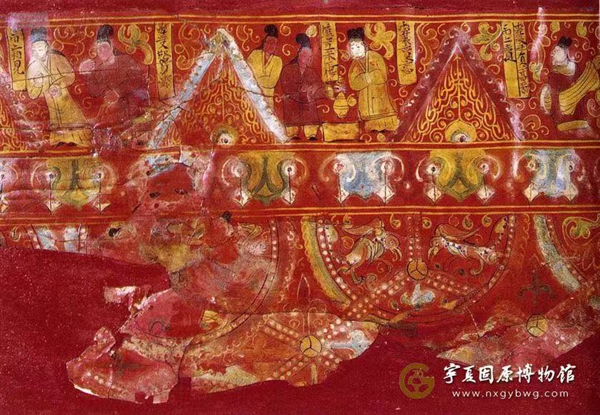
Painted over 1,500 years ago, this lacquered coffin offers a timeless glimpse into the spiritual world of the Northern Wei Dynasty (AD 386-534). [Photo/www.nxgybwg.com]
Adjacent to this is the Xiji Museum, which holds a collection of 4,087 items, including five national first-class cultural relics. The museum spans three floors: the first floor features the introductory hall, an audiovisual room, a temporary exhibition area, and an exhibit on the development of civil aviation; the second floor presents "The Stories of the Hulu River", highlighting local historical artifacts; and the third floor shows "The Ancient Coin and Treasures", tracing the evolution of currency across dynasties. These displays illustrate both the transformation of currency and the socio-economic contexts of ancient times.
Furthermore, the Northwest Farming Culture Museum, a national second-class museum, focuses on agricultural heritage in northwest China. It holds over 10,000 modern and contemporary farming tools, including two national first-class cultural relics. It is open year-round with free entrance. Its featured exhibition, "The Soul of Farming", comprises seven sections tracing agricultural development from prehistoric times to the modern era, underscoring the perseverance and resilience of the local people in harsh natural environments.