How Guyuan's vegetables won Cantonese hearts: Story behind Ningxia choy sum


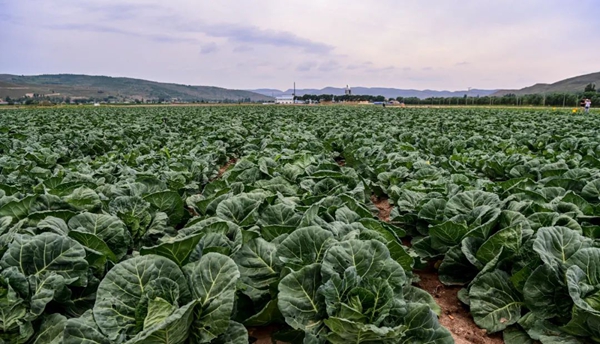
Neatly arranged rows of choy sum plants. [Photo/Guyuan Daily]
Known as the "culinary paradise", Guangzhou, capital of Guangdong province, is home to a wide variety of delicacies. Yet, in the eyes of its food-savvy locals, a simple dish of greens is regarded as a truly tasty dish — and it's called choy sum. Cantonese people affectionately call it "Ningxia choy sum".
The cultivation of Ningxia choy sum can be observed in Guyuan, Ningxia Hui autonomous region. It is widely grown in areas such as Yuanzhou district, Xiji county, Longde county, and Pengyang county, with Yuanzhou district having the largest cultivation area.
To date, the city has established 14 choy sum production bases, with a total planting area of 50,000 mu (3,333.33 hectares).
Enterprises from the Guangdong-Hong Kong-Macao Greater Bay Area have introduced standardized cultivation methods to Guyuan. Smart irrigation systems and drone-based aerial spraying have made local farming more precise and modernized, while the highly efficient "cold storage + cold-chain logistics" model ensures that choy sum can be delivered from the fields to dining tables in Guangzhou — over 2,000 kilometers away — within just 28 hours.
Guyuan's green vegetables extend far beyond just choy sum. In recent years, the city has even developed into a national production and supply base for high-quality green vegetables. It has also established a regional public brand known as "Liupanshan Green Vegetables", cultivated 18 national geographical indication protected products, and built over 130 large-scale cultivation bases.
The area dedicated to green vegetable farming has remained stable at over 500,000 mu, with an annual output exceeding 2 million metric tons of fresh vegetables, including choy sum, broccoli, and peppers.
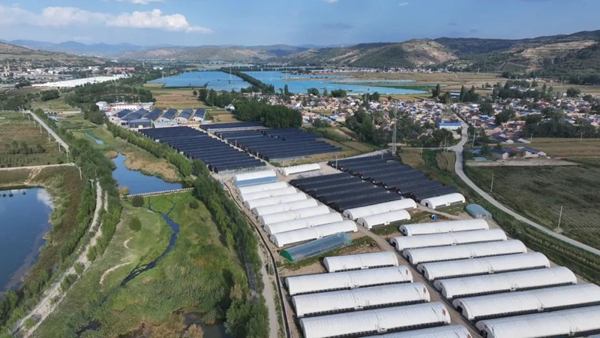
Choy sum production bases in Guyuan. [Photo/Guyuan Daily]