
Hai'an's Yazhou Modern Agriculture Park boosts crop yields with advanced tissue culture technology
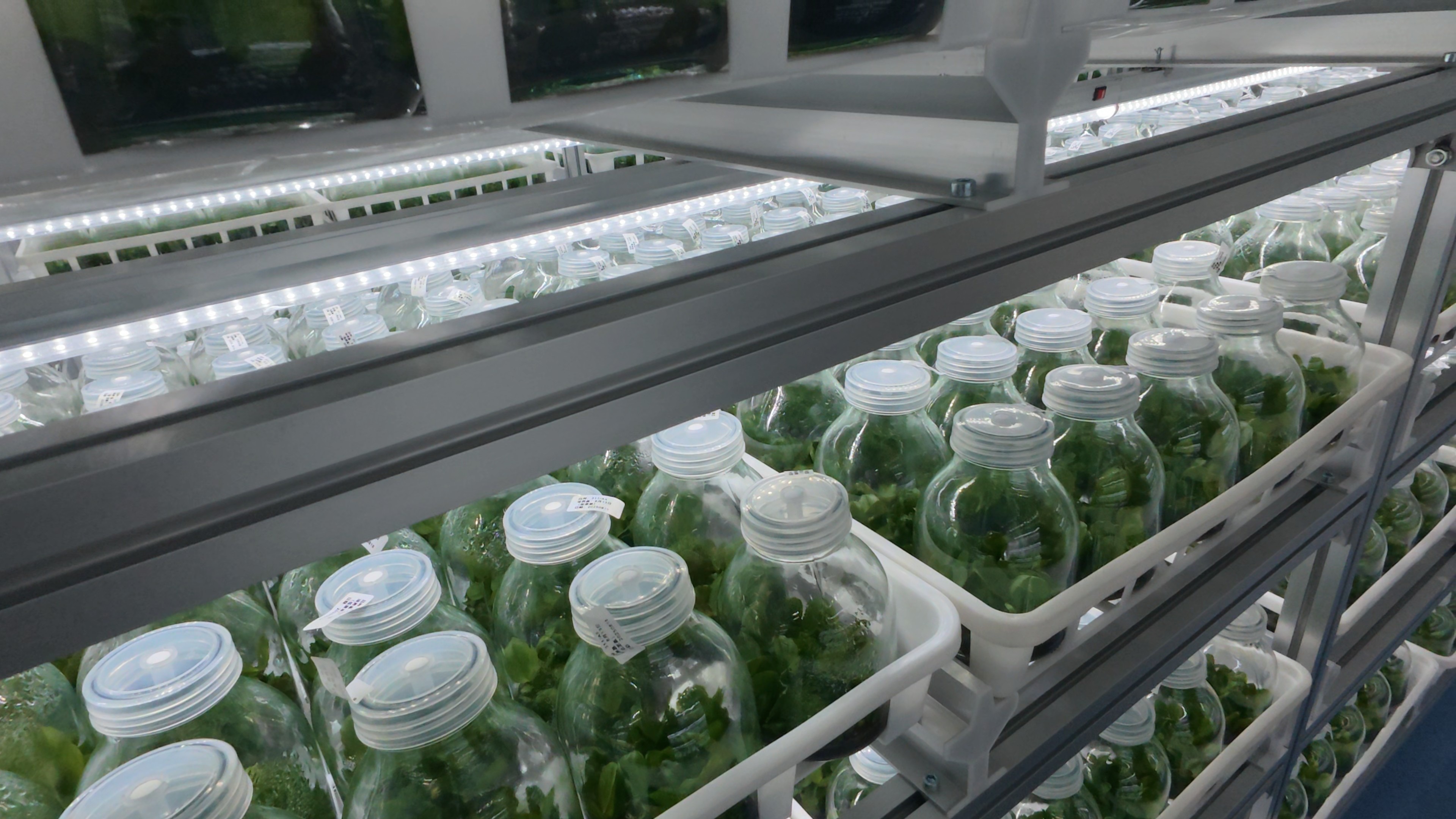
Seedlings at a tissue culture center in Yazhou Modern Agriculture Park in Hai'an, Nantong. [Photo/Nantong Daily]
Hai'an's Yazhou Modern Agriculture Park has established a state-of-the-art tissue culture center that combines advanced lab techniques with intelligent management systems.
The center produces an average of 2 million high-quality seedlings annually, three times the output of traditional nurseries, while addressing common challenges such as rapid variety degeneration, pest and disease risks, and long cultivation cycles. The seedlings boast stronger root systems and uniform growth, helping field yields increase by more than 30 percent.
Tissue culture involves sterile isolation, inoculation, and cultivation to generate complete plants. Compared with conventional field propagation, this method allows rapid multiplication while maintaining the original variety's desirable traits.
Ensuring genetic purity begins with the careful selection of mother plants. In the center's mother plant area, over 600 varieties, including flowers, medicinal herbs, and fruits and vegetables, are neatly organized. Technicians select robust plants with superior traits, conducting disease-resistance tests and growth stability assessments. Only top-performing plants make it onto the cloning list.
Scientific nutrient management is key to unlocking the seedlings' potential. Customized formulations, developed through targeted hybridization and molecular marker technologies, support growth across three stages — seedling, mid-growth, and mature plant — with nutrient recipes adjusted for each stage.
Since its launch in Hai'an last year, Keteng Biotech has produced 3 million tissue-cultured seedlings annually. Liu Li, the general manager, noted, "We follow a production-to-order model. We've already received orders for 2 million seedlings, mainly from the Yangtze River Delta, with clients from Guangzhou also placing orders."
The company also collaborates with research institutions such as Nanjing Agricultural University and the Jiangsu Academy of Agricultural Sciences. Acting as a pilot base for industrialization, it translates laboratory breeding achievements into large-scale production, combining academic innovation with factory-scale propagation to accelerate agricultural development.

