
Cangxi primary school wins provincial award for promoting heritage
Lijiang stilt walking, an online performance submitted by Lijiang Primary School in Cangxi county, Sichuan province, recently won the Second Prize in the Local Cultural Talent Category at the 5th Sichuan Rural Cultural Revitalization Charm Competition.

Lijiang Primary School pockets the award. [Photo provided to cngy.gov.cn]
Teachers and students from Lijiang Primary School brought Lijiang stilt walking, a representative item of Sichuan Provincial Intangible Cultural Heritage, to the provincial-level exhibition platform, vividly demonstrating the unique charm of this cultural treasure.
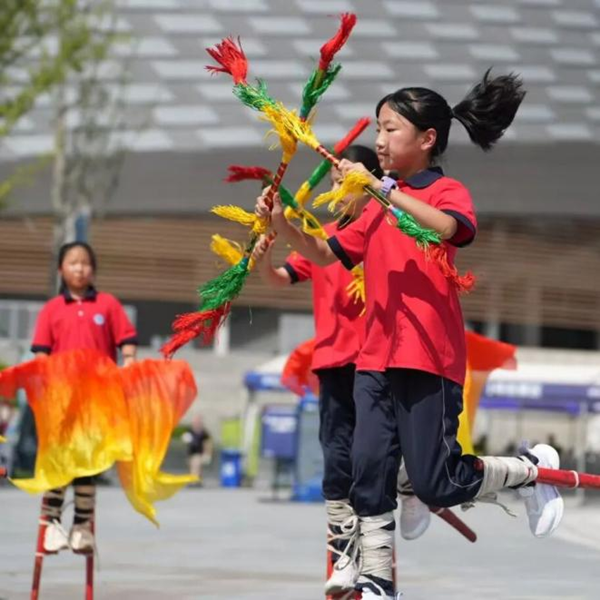
Primary school students perform stilt walking. [Photo provided to cngy.gov.cn]
Lijiang stilt walking is a traditional sports activity unique to Lijiang town, Cangxi county. Its history dates back to the large-scale migration from Hubei and Hunan to Sichuan during the Kangxi reign of the Qing Dynasty (1636-1912), boasting an inheritance history of over 300 years. The art form is divided into two major schools: Wenqiao (literary stilts) and Wuqiao (martial stilts).
Wenqiao features opera character makeup and exaggerated movements, while Wuqiao includes competitive items such as skipping rope and spinning on stilts. In April 2023, it was included in the Sixth Batch of Representative Items of Sichuan Provincial Intangible Cultural Heritage.
Lijiang Primary School has reportedly introduced and inherited Wuqiao since 1999. Through the unremitting efforts of teachers and students, stilt walking at the school has evolved from a "campus activity" to a key feature. The institute has been recognized as a Model School for Inheriting Excellent Traditional Chinese Culture.
Today, ICH stilt walking has not only become the school's "cultural symbol" but also a national model for "developing schools with distinctive features" in rural education.
The achievement is a concrete result of the local government's continuous efforts to promote the "ICH Campus Program" and deepen the integration of cultural education into campus life. It demonstrates the vivid practices of young people in inheriting and promoting traditional culture, accumulating valuable experience for further advancing education about ancient aesthetics and cultural appreciation in local schools.