
- Home
- Media Center
-
Events
- Wuzhen Summit
- Regional Forums
- Practice Cases of Jointly Building a Community with a Shared Future in Cyberspace
- World Internet Conference Awards for Pioneering Science and Technology
- The Light of Internet Expo
- Straight to Wuzhen Competition
- Global Youth Leadership Program
- WIC Distinguished Contribution Award
- Membership
- Research & Cooperation
- Digital Academy
-
Reports
- Collection of cases on Jointly Building a Community with a Shared Future in Cyberspace
- Collection of Shortlisted Achievements of World Internet Conference Awards for Pioneering Science and Technology
- Reports on Artificial Intelligence
- Reports on Cross—Border E—Commerce
- Reports on Data
- Outcomes of Think Tank Cooperation Program
- Series on Sovereignty in Cyberspace Theory and Practice
- Other Achievements
- About WIC
- 中文 | EN


WIC releases Global AI Standards Development Report


On Nov 9, the Standards Program of World Internet Conference (WIC) Specialized Committee on Artificial Intelligence officially released the research outcome — the Global Artificial Intelligence Standards Development Report (hereinafter referred to as the Report) — at the 2025 WIC Wuzhen Summit. John Higgins CBE, co-lead of the Standards Program and chairman of the International AI Governance Association (IAGA), presented the key findings and forward-looking recommendations of this joint research effort.
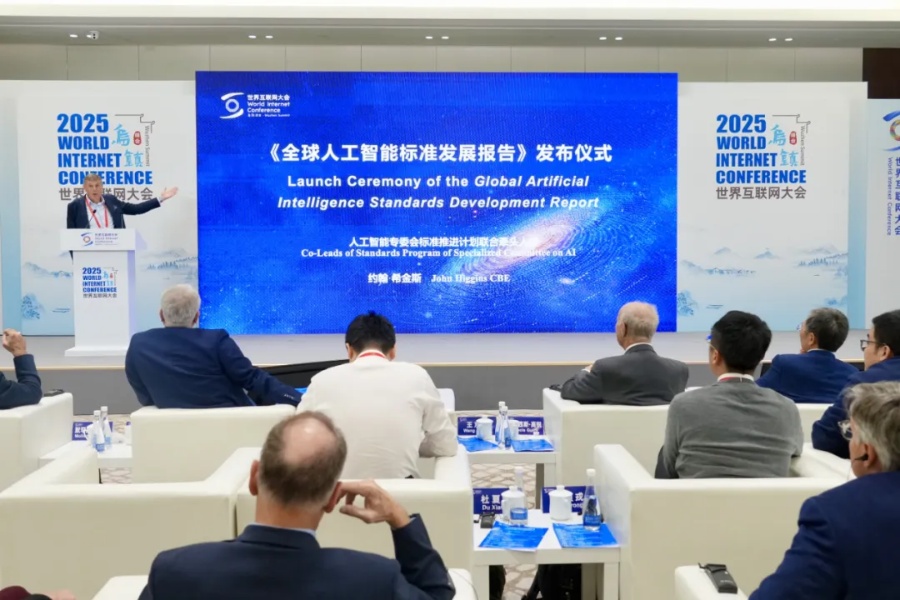
Grounded in a global perspective, the Report provides a systematic analysis of the current state and emerging trends of international AI standardization. It identifies key challenges and offers concrete recommendations for developing responsible AI standards. It also emphasizes that global cooperation is the key pathway to building an inclusive, interconnected, and sustainable AI standardization system. Achieving this goal requires joint efforts from international organizations, governments, industries, and research institutions to address challenges, and to continuously advance the formulation and implementation of responsible AI standards.

According to the Report, the development of global AI standards currently faces four major challenges: dilemma of standard lag caused by advanced technology iteration; complexity of the industrial chain increases the difficulty of standard-setting; divergences in governance concepts among major economies raise the threshold for standard consensus; and practical gaps in Global South lead to insufficient participation in standard-setting. To address these issues, the Report stresses that advancing global AI standards is not a task for any single actor but a systemic global endeavor. It calls for: (1) international organizations to focus on standard coordination and play a leading role; (2) governments to strengthen overall planning to promote mutual learning and recognition of standards; (3) industries to focus on technological contributions and collaboration to accelerate the application and transformation of standards; (4) research institutions to deepen basic theoretical research to support cutting-edge exploration and talent development.
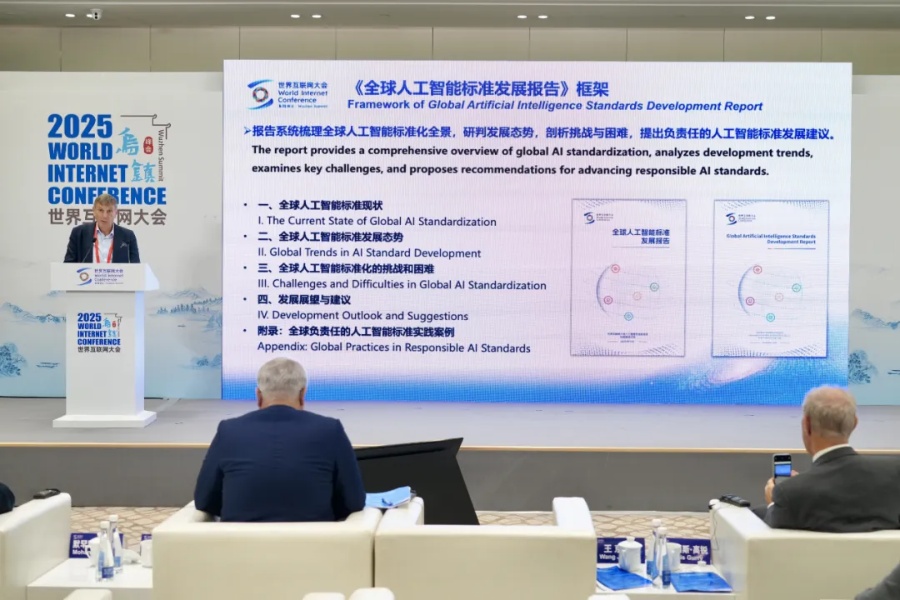
At present, advancing global AI standardization has become a key mission for fostering technological progress and improving governance frameworks. As an important milestone in this process, the Global Artificial Intelligence Standards Development Report provides the international community with a comprehensive reference to understand the evolving landscape of AI standards. It also offers valuable insights to industry, academia, and policymakers seeking to enhance cross-sector collaboration. The release of this Report marks a significant step toward promoting the principles of responsible AI, contributing to the creation of a more open, inclusive, and sustainable global AI standards ecosystem.
The World Internet Conference (WIC) was established as an international organization on July 12, 2022, headquartered in Beijing, China. It was jointly initiated by Global System for Mobile Communication Association (GSMA), National Computer Network Emergency Response Technical Team/Coordination Center of China (CNCERT), China Internet Network Information Center (CNNIC), Alibaba Group, Tencent, and Zhijiang Lab.