
- Home
- Media Center
-
Events
- Wuzhen Summit
- Regional Forums
- Practice Cases of Jointly Building a Community with a Shared Future in Cyberspace
- World Internet Conference Awards for Pioneering Science and Technology
- The Light of Internet Expo
- Straight to Wuzhen Competition
- Global Youth Leadership Program
- WIC Distinguished Contribution Award
- Membership
- Research & Cooperation
- Digital Academy
-
Reports
- Collection of cases on Jointly Building a Community with a Shared Future in Cyberspace
- Collection of Shortlisted Achievements of World Internet Conference Awards for Pioneering Science and Technology
- Reports on Artificial Intelligence
- Reports on Cross—Border E—Commerce
- Reports on Data
- Outcomes of Think Tank Cooperation Program
- Series on Sovereignty in Cyberspace Theory and Practice
- Other Achievements
- About WIC
- 中文 | EN


Highlights of 2025 WIC: Connecting civilizations through digitalizing cultural heritage


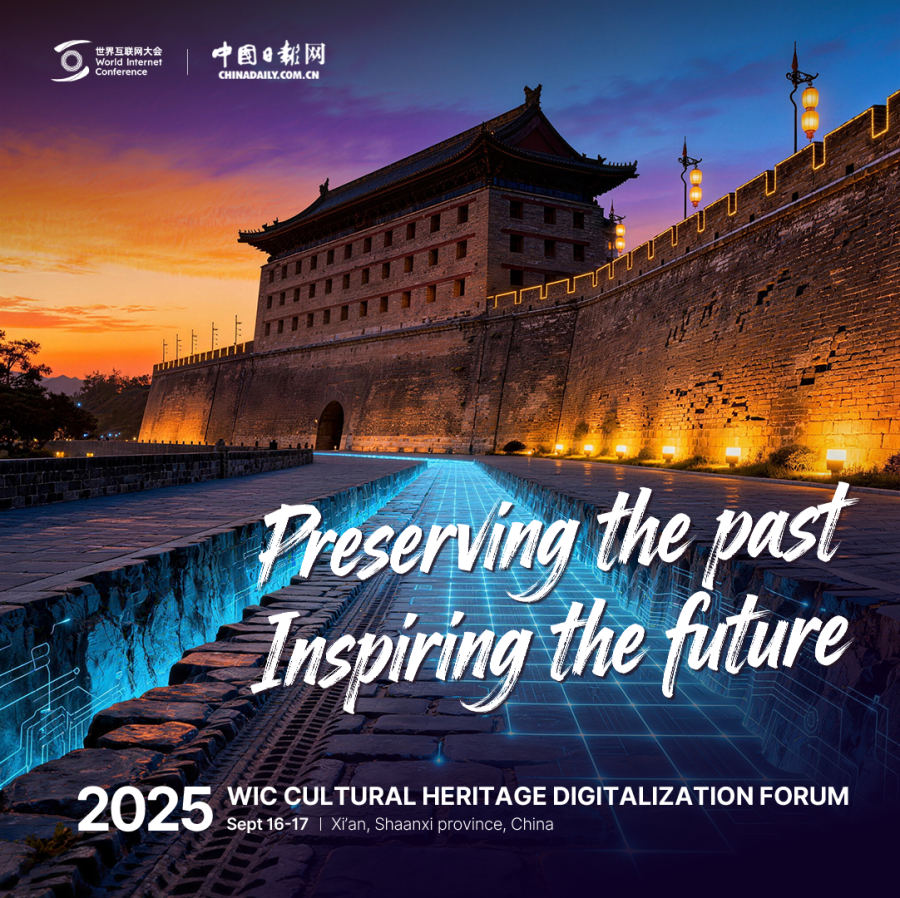
Among the key events staged by the World Internet Conference (WIC) in 2025, the WIC Cultural Heritage Digitalization Forum drew global attention to how digital technology is actively reshaping the preservation, inheritance and exchange of civilizations.
The forum was held on Sept 16 and 17 in Xi'an, capital of Northwest China's Shaanxi province. Under the theme of "Bridging History through Digitalization, Building Civilization with Intelligence," it attracted senior representatives from international organizations, government departments, cultural institutions and academia to explore new pathways for safeguarding cultural heritage in the digital age.
Discussions focused on key topics including preservation and inheritance, technological innovation, industrial empowerment, as well as openness and collaborative governance.
Speakers widely agreed that digital technologies such as artificial intelligence (AI), virtual reality and high-precision digitization are transforming cultural heritage from static preservation into dynamic, accessible and shareable global assets.
Ren Xianliang, secretary-general of the WIC, said cultural heritage carried the collective memory of human civilization, while digital technology had become a powerful tool to protect and revitalize it.
Ren added that hosting the forum in Xi’an, one of China's most historic cities, highlighted both the global trend towards digital civilization and the WIC's commitment to promoting digital solutions for cultural heritage protection.
Francis Gurry, vice-chair of the WIC, said that digital innovation was playing an essential role in maintaining continuity between past, present and future in a world rapidly evolving through technological advances.
He also praised China for fostering impressive international partnerships in cultural preservation, transcending political differences and for reinforcing culture as a bridge for peaceful coexistence.
Latif Ladid, founder and president of the IPv6 Forum, noted that cultural heritage digitalization was not only a cultural issue, but also a long-term technological challenge.
In this context, technologies such as cloud computing, device identification and next-generation internet protocols like IPv6 were fundamental to ensuring the long-term preservation, traceability and accessibility of digital heritage, he added.
According to Ladid, understanding humanity's origins and achievements through digital heritage helps cultivate respect for life, inspires future generations and strengthens societal values.
He stated that the forum initiated a new platform for further global cooperation and it was likely to keep expanding as the representatives returned home with concrete ideas for collaboration.
Alongside the forum, an exhibition of outstanding cultural heritage digitalization projects showcased nearly 100 initiatives from institutions worldwide.
From the AI-powered restoration of ancient books and immersive digital experiences of historical sites to interactive displays of intangible cultural heritage, the exhibition demonstrated how technology can bring history closer to contemporary life.
By providing a global platform for dialogue, experience sharing and cooperation, the forum underscored the growing consensus that digitalization is not only a means of preserving the past, but also a bridge connecting civilizations across time, space and cultures.
The World Internet Conference (WIC) was established as an international organization on July 12, 2022, headquartered in Beijing, China. It was jointly initiated by Global System for Mobile Communication Association (GSMA), National Computer Network Emergency Response Technical Team/Coordination Center of China (CNCERT), China Internet Network Information Center (CNNIC), Alibaba Group, Tencent, and Zhijiang Lab.