
- Home
- Media Center
-
Events
- Wuzhen Summit
- Regional Forums
- Practice Cases of Jointly Building a Community with a Shared Future in Cyberspace
- World Internet Conference Awards for Pioneering Science and Technology
- The Light of Internet Expo
- Straight to Wuzhen Competition
- Global Youth Leadership Program
- WIC Distinguished Contribution Award
- Membership
- Research & Cooperation
- Digital Academy
-
Reports
- Collection of cases on Jointly Building a Community with a Shared Future in Cyberspace
- Collection of Shortlisted Achievements of World Internet Conference Awards for Pioneering Science and Technology
- Reports on Artificial Intelligence
- Reports on Cross—Border E—Commerce
- Reports on Data
- Outcomes of Think Tank Cooperation Program
- Series on Sovereignty in Cyberspace Theory and Practice
- Other Achievements
- About WIC
- 中文 | EN


Highlights of 2025 WIC: WIC advances connectivity, builds prosperity through Digital Silk Road


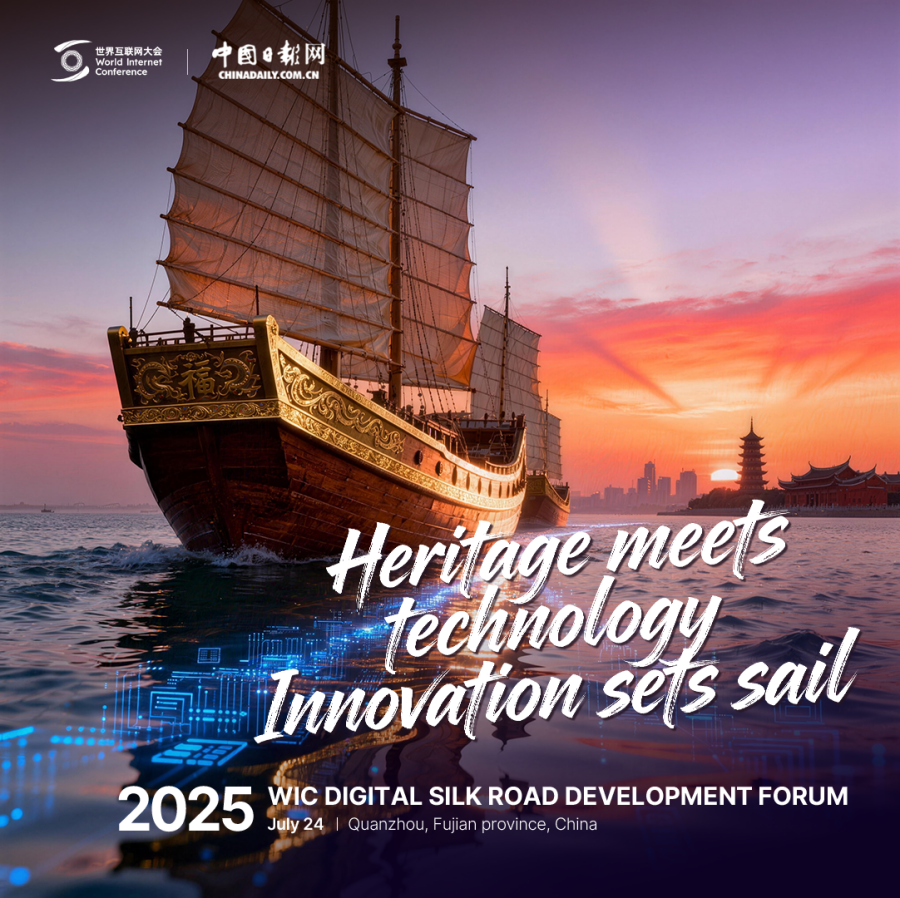
In July 2025, the World Internet Conference (WIC) really brought the concept of the Digital Silk Road again into focus.
That happened when the WIC Digital Silk Road Development Forum was held in Quanzhou city of East China’s Fujian province, the historic starting point of the ancient Maritime Silk Road.
Held under its theme of “Embracing the Digital and Intelligent Maritime Silk Road -- Jointly Building a Community with a Shared Future in Cyberspace,” the event highlighted just how digital technology is reshaping traditional pathways of connectivity.
Discussions centered on digital trade under the Belt and Road Initiative, AI-driven private sector development, as well as smart, sustainable international transport — reflecting a growing consensus that connectivity in the digital era extends far beyond physical infrastructure to encompass data flows, platforms and innovation ecosystems.
At a news conference ahead of the forum, Ren Xianliang, secretary-general of the WIC, said that hosting the event in Quanzhou was both a tribute to shared historical memory and a call to deepen digital cooperation.
He stressed the importance of advancing collaboration in areas such as cross-border e-commerce, data connectivity and smart port development, in order to translate the Silk Road spirit into concrete digital practices.
Zhao Houlin, former secretary-general of the International Telecommunication Union, noted that fragmentation, the digital divide and geopolitical issues remained challenges in cyberspace, adding that it was of great significance to build an open and inclusive platform.
He also pointed out that while countries differ in their conditions, they share the same development goals, enabling China to share its development experiences with other developing countries to support innovative solutions.
The forum brought together senior representatives from international organizations, governments of Belt and Road countries, internet companies and academia.
Activities included discussions on AI governance, training programs on digital innovation and cultural performances showcasing the fusion of digital technology and traditional arts — reflecting the forum’s emphasis on both economic development and cultural exchanges.
Looking beyond Quanzhou, the 2025 WIC Digital Silk Road Development Forum echoed themes including connectivity, shared prosperity and inclusive digital growth.
Together, these discussions reinforced the idea that the Digital Silk Road is not a single project, but is rather an evolving framework for cooperation — seeking to align technological progress with openness, sustainability and mutual benefit.
The WIC Digital Silk Road Development Forum in 2025 was said to really stand out as a vivid illustration of how ancient routes of exchange are being reimagined in the digital age — linking regions not only through trade and infrastructure, but through shared innovation and a common vision for the future of cyberspace.
The World Internet Conference (WIC) was established as an international organization on July 12, 2022, headquartered in Beijing, China. It was jointly initiated by Global System for Mobile Communication Association (GSMA), National Computer Network Emergency Response Technical Team/Coordination Center of China (CNCERT), China Internet Network Information Center (CNNIC), Alibaba Group, Tencent, and Zhijiang Lab.