
Camellia oil trees turn Cangxi's wasteland green and wealthy
In early winter, the Camellia Oleifera Industrial Park in Hongyang village, Qiping town, Cangxi county, Sichuan province, is adorned with blooming camellia flowers, creating a picturesque scene that attracts hundreds of visitors daily.
"On sunny days, hundreds of people come to enjoy the flowers and take photos," said Wu Daiyong, Party secretary of Hongyang village.
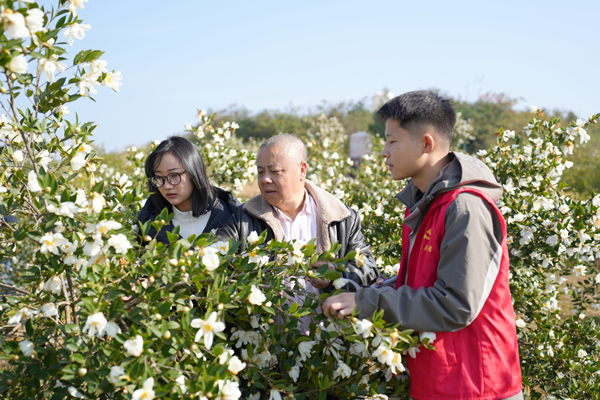
Camellia flowers bloom in Hongyang village's Camellia Oleifera Industrial Park. [Photo provided to cngy.gov.cn]
Once a barren hillside where crops failed to thrive, the village transformed its fate in 2019.
After studying camellia oil plantations in Guangxi, Wu discovered the plant's resilience to poor soil and drought, along with its economic potential. By the end of that year, over 40,000 camellia saplings had been planted across the wasteland.
Four years later, the park now features the unique "flowers and fruits on the same tree" phenomenon. In the first harvest year, the fresh fruit yield brought in approximately 3,000 yuan per mu ($6,300 per hectare). Today, Hongyang village and neighboring areas have expanded the plantation to nearly 900 mu.
To maximize profits, the village built a fruit drying workshop and partnered with deep-processing enterprises. They developed premium products like "Specialty Pressed Camellia Oil" and "Bottled Camellia Oil", branding them under "Hongbaoliangshan". These high-quality oils have gained a loyal customer base, generating over three million yuan in annual revenue.
The once-abandoned land has now become a source of hope and income, turning Hongyang village into a model of rural vitalization through sustainable agriculture.