



Zhejiang seeks to realize value of ecological assets
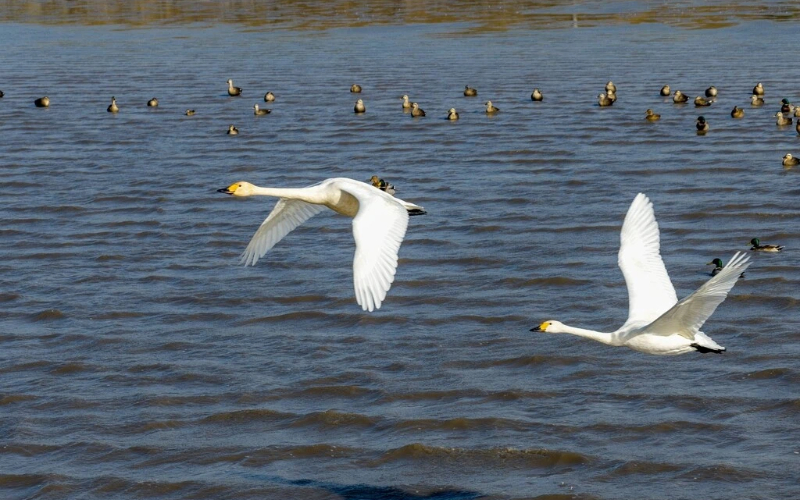
Swans fly over a wetland in Shangyu district, Shaoxing, Zhejiang province, on Nov 25, 2025. [Photo/IC]
Zhejiang is stepping up efforts to turn ecological resources into economic and social value, as biodiversity conservation and sustainable use gain a higher policy profile, according to the 2026 provincial government work report.
The report said Zhejiang became the first province in China to complete a full county-level biodiversity survey in 2025. The survey recorded about 13,600 species, providing the most comprehensive picture to date of the province's biological resources and laying the groundwork for coordinated protection and innovative utilization.
Officials said the detailed inventory marks a shift from basic resource identification to a new stage that integrates ecological conservation with development planning. Biodiversity is increasingly being treated as an asset that can support education, tourism, research, and green industries.
To date, Zhejiang has established 45 provincial-level biodiversity experience sites and promoted the development of biodiversity-friendly units. In Dinghai district of Zhoushan, for example, six science education venues, including a marine bird exhibition center, have been built.
The district has developed 15 study tour programs and attracted more than 50,000 visitors since August 2024. During the biodiversity survey, Dinghai also documented 80 types of traditional ecological knowledge and established a dedicated database.
Zhejiang has also advanced work on aquatic genetic resources. In 2025, the province released the results of its aquaculture germplasm survey, identifying 326 aquaculture genetic resources, ranking second nationwide.
Data showed that in 2024, improved aquaculture breeds covered 92 percent of Zhejiang's farming area, while the province's fishery output value rose 8.3 percent year-on-year. Zhejiang has built a coordinated germplasm preservation system, centered on a main repository in Hangzhou, supported by freshwater and seawater repositories in Huzhou, southern Zhejiang, and northern Zhejiang.
