

Pudong creates seamless trade network

Products from 39 countries are showcased at Waigaoqiao Global Hub in Pudong. [Photo by Zheng Feng/chinanews.com.cn]
Five years into its journey as a designated pioneer area for socialist modernization, Shanghai's Pudong New Area continues to set the pace for international commerce.
Through innovative policies and improved services, Pudong has created a seamless trade network that connects the world more efficiently.
Imagine a Thai mangosteen picked in Bangkok one day and available in a Chinese market the next, or Chinese solar panels swiftly dispatched from Pudong's overseas warehouses to Kazakhstan. This is the reality of Pudong's vibrant trade environment, reflecting China's commitment to global openness.
The Waigaoqiao Global Hub in Pudong now hosts 39 country centers, including 18 from Silk Road e-commerce partner countries. Here, products like Thai rice, Pakistani crafts, and Uzbek dried fruits are showcased and matched with Chinese buyers. At the same time, Chinese goods like home products and electronics are finding their way into international markets.
Jia Guolin, a manager at the Shanghai Waigaoqiao International Trade Operations Center, said that by combining the strengths of the Waigaoqiao Free Trade Zone and the Silk Road e-commerce initiative, the Global Hub has become a dynamic trade ecosystem.
Success stories include the Pakistan Center's popular live-stream sales on Douyin (Chinese version of TikTok) and the Syria Center's dual approach involving both online and offline sales, generating about 10 million yuan (about $1.4 million) in trade in 2024. The France Center has expanded into high-end markets, with French wines featured in duty-free stores and first-class airline dining, and is expecting a 150 percent trade increase in 2025.
For businesses, efficient customs clearance and cost savings are crucial. Over the past five years, Pudong has tackled trade barriers with innovative solutions.
The cross-border e-commerce export model (9610) has been expanded in Pudong, facilitating small, frequent B2C shipments. This model reduces costs and complexity, making it easier for businesses to handle taxes and rebates.
Wang Ping, an official of Pudong's commerce commission, said that Pudong has established data-sharing with Thailand and explored cross-border e-commerce connections with Kazakhstan. This simplifies customs processes, eliminating repetitive paperwork for importers.
Additionally, Pudong has integrated bonded and e-commerce goods, enabling consolidated shipping, reducing storage costs, and shortening delivery times.
Moreover, the Shanghai Petroleum and Natural Gas Exchange has partnered with UAE and Saudi companies for oil and gas trade using RMB settlements, making global procurement more flexible.
By removing barriers and building open platforms, Pudong has made global trade easier. As it continues to open its doors wider, the district is set to write new chapters in the story of international commerce.
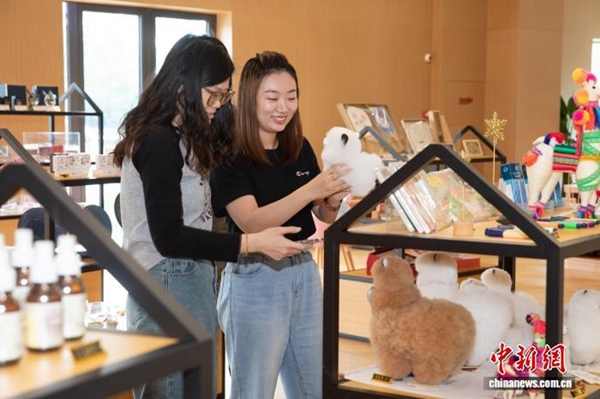
Global products are matched with Chinese buyers via Waigaoqiao Global Hub. [Photo by Zheng Feng/chinanews.com.cn]
 Things you should know about CIIE 2025
  Pudong New Area's Leap Forward: 14th Five-Year Plan Triumphs
  China's key progress in 14th Five-Year Plan period
  play
play 