

From Nov 14 to 16, the 27th China International Hi-Tech Fair took place in Shenzhen, Guangdong province, where the Grand Union of Innovation (GUi) made its third appearance, presenting a dynamic array of enterprises.
This year's exhibition showcased a diverse range of state-of-the-art technologies across seven main areas: quantum security, millimeter-wave medical detection, digital twins, bio-based materials, virtual interaction, embodied intelligence, and infrared sensing.
These innovations demonstrate GUi's ongoing efforts to build a robust innovation ecosystem. In recent years, GUi has improved each stage of the innovation process — from idea validation and pilot projects to scene innovation and capital partnerships.
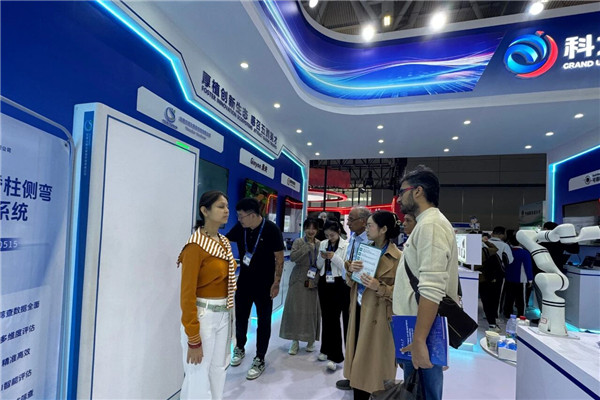
Global visitors listen to a presentation at GUi's exhibition booth. [Photo/GUi]
Notable exhibits included the quantum-secure intelligent seal from Anhui Yunxi Quantum Technology, which addresses traditional risks in seal management through AI and quantum encryption.
Another highlight was the millimeter-wave spinal screening device from Yuanshuo Terahertz Technology, which offers a non-invasive, low-cost, high-efficiency solution for large-scale medical screening.
Anhui Zhongke Lingxi Technology displayed a multi-solution dexterous hand matrix. These robotic hands can perform delicate tasks in complex environments, showcasing the "end-effector" capabilities for embodied AI.
In the field of digital space technologies, GUi presented companies like Hefei TU Reality Technology, which offers 3A-grade virtual human architecture, Hefei Ginyon Technology, which advances digital twins into real-time decision-making engines, and Anhui Sci Visual Technology, which transforms cutting-edge technology into immersive learning experiences.
Additionally, Anhui BioMac Materials Technology showcased its bio-based nylon technology, while Hefei Airvisen Technology brought forward infrared sensing products for enhanced perception capabilities.
These projects, although varied, form a clear image of GUi's growing city-level innovation ecosystem, which links research, engineering, industry, and capital in a seamless cycle.
The cycle includes concept validation, pilot engineering, application-driven innovation, university and technology managers, and a funding system. These interconnected stages ensure innovation to thrive and scale, offering startups a solid path from research papers to tangible products in high-risk areas.
GUi functions as an "innovation organism," where research acts as the nervous system, engineering serves as the bones, industry forms the muscles, and capital flows as the blood. Through exhibitions and events, GUi illustrates how it weaves together the city's vast tech resources into a sustainable and dynamic innovation ecosystem.
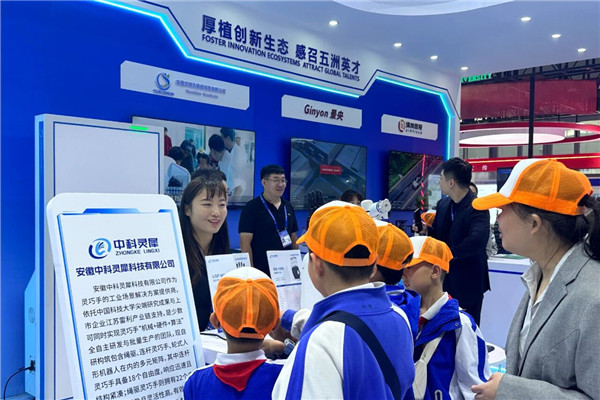
Young attendees show strong interest in GUi's technology displays. [Photo/GUi]
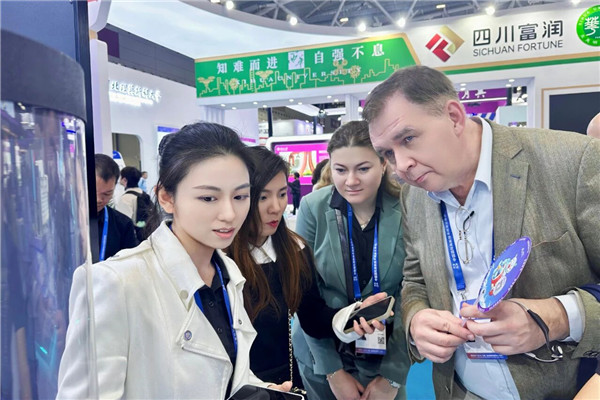
International participants engage with GUi's cutting-edge exhibits. [Photo/GUi]
 Scan the QR code to follow us on WeChat