


On May 8, the UNESCO Memory of the World Asia-Pacific Regional Committee announced that the "Huizhou Manuscripts - Millennial Clan Archives of Huizhou" has been successfully inscribed on the Asia-Pacific Register. This marks the first time a project from Anhui Province has achieved this recognition, further enhancing the international profile of Huizhou studies and cultural heritage.
At the committee's tenth meeting in Mongolia, the Huizhou Manuscripts were selected alongside "The Dege Sutra Printing House Woodblocks" and "The Old Teahouse Archives of Chengdu." This brings the total number of Chinese entries on the Asia-Pacific Register to 17.
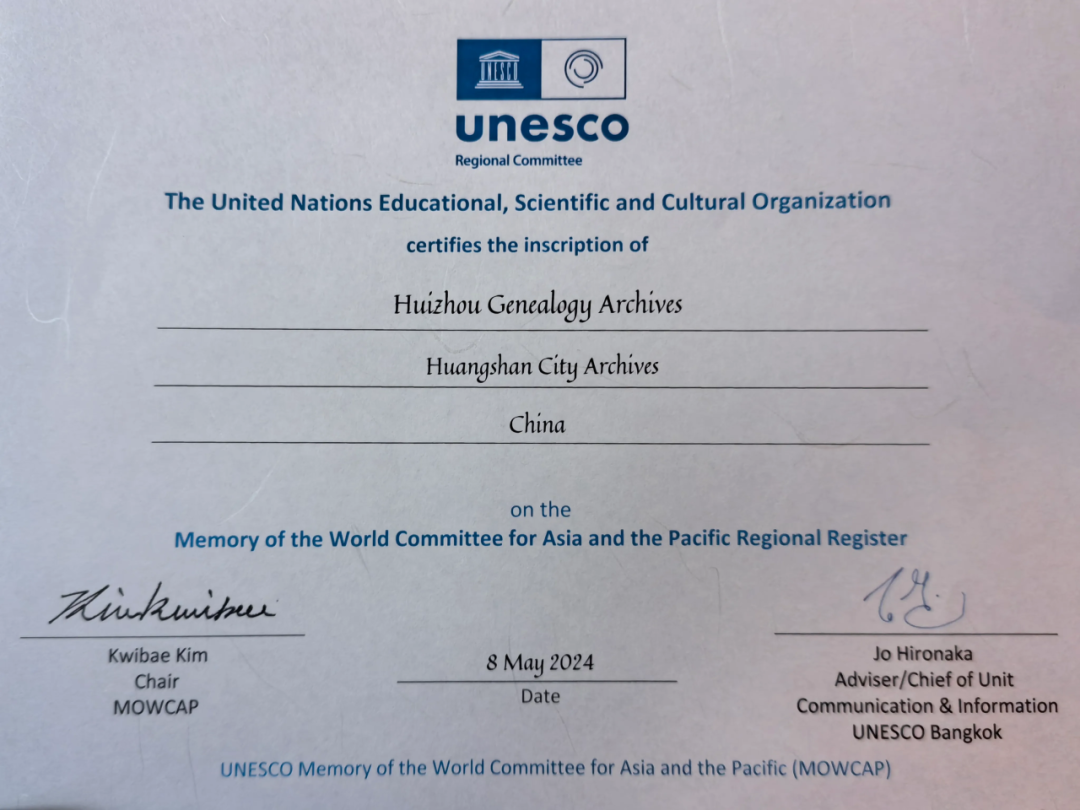
The UNESCO Memory of the World Asia-Pacific Regional Committee announced that the "Huizhou Manuscripts - Millennial Clan Archives of Huizhou" has been successfully inscribed on the Asia-Pacific Register. [Photo/Huangshan Daily]
The Huizhou Manuscripts, which have endured for over a thousand years, are invaluable for studying and preserving Huizhou culture and Chinese history. Comprising 427 sets and 2,235 volumes, these archives span the Song, Yuan, Ming, Qing, and Republican periods. They provide a comprehensive record of family histories, governance, and cultural practices in the Huizhou (Huangshan) region.
An example from the Qing dynasty Wang family genealogy includes ten family precepts emphasizing values like filial piety and brotherhood. Such documents have significant historical and cultural value, preserving family traditions and morals.
The archives not only document political, economic, and cultural aspects of families but also record significant historical events, local customs, landmarks, and festivals. They are crucial for research in archival science, history, cultural anthropology, and folklore.
Other entries, such as the Chengdu Old Teahouse Archives and the Dege Sutra Printing House Woodblocks, also highlight the rich cultural heritage of their respective regions, contributing to the broader understanding of Chinese cultural history.